
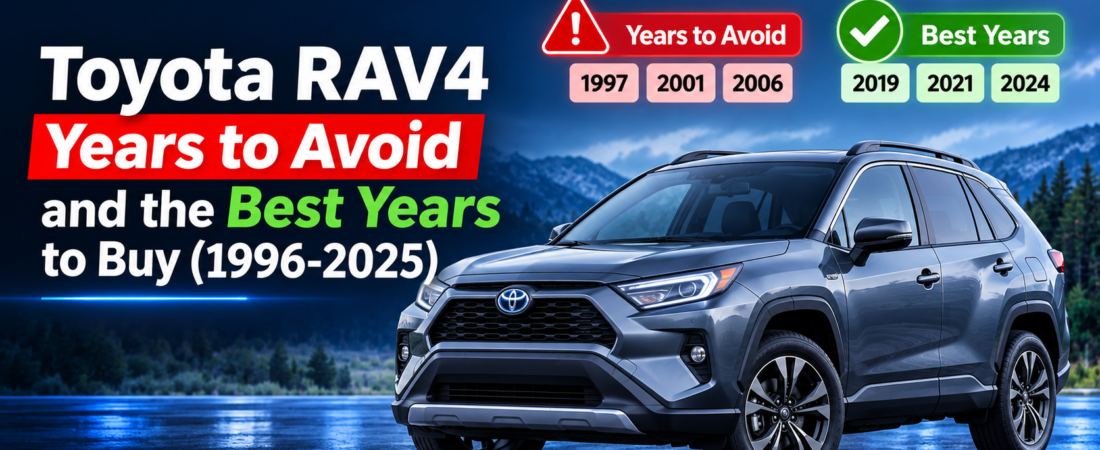
The Toyota RAV4 is the compact SUV that many used shoppers buy without a second thought, and most of the time that instinct is right. RepairPal rates the RAV4 4.0 out of 5 for reliability, ranks it third out of 26 compact SUVs and puts average annual repair costs at $429, against $521 for the class. But the RAV4’s record is not flat. A handful of model years have documented oil consumption, transmission and recall problems, and knowing the Toyota RAV4 years to avoid before you shop can save you thousands of dollars.
In this guide, AutoPeeky ranks every RAV4 model year from 1996 to 2025 using owner complaint data from CarComplaints.com, recall information, repair-cost research and published reliability guides. We cover the RAV4 Hybrid, the fifth generation, the 2008 model that many shoppers ask about, and how long a RAV4 can realistically last.
Before you look at a specific car, run it through our Should I Buy? tool. Enter the year, make and model and you get an instant look at that vehicle’s NHTSA complaint history and open recalls.
Toyota RAV4 Years to Avoid at a Glance
Here is AutoPeeky’s ranking for every RAV4 generation:
| Generation | Best years | Acceptable with checks | Years to avoid |
| First generation (1996-2000) | 1998 | 1997, 1999, 2000 | 1996 |
| Second generation (2001-2005) | 2004, 2005 | None | 2001, 2002, 2003 |
| Third generation (2006-2012) | 2011, 2012 | 2009, 2010 | 2006, 2007, 2008 |
| Fourth generation (2013-2018) | 2016, 2017, 2018 | 2014, 2015 | 2013 |
| Fifth generation (2019-2025) | 2021, 2022, 2025 | 2020, 2023, 2024 | 2019 |
| Sixth generation (2026 onward) | Too new to rank | Too new to rank | Too new to rank |
The quick answer: the Toyota RAV4 years to avoid are 2001 to 2003, 2006 to 2008, 2013 and 2019. The 2019 is the worst of the modern cars, while the 2002 and 2007 have the highest complaint counts of any RAV4 year. The best years to buy are 2021, 2022 and 2025, and the 2016 to 2018 and 2011 and 2012 models are the best older values.
Toyota RAV4 Generations
| Generation | Years | What to know |
| First | 1996 to 2000 | Small and simple, now more than 25 years old |
| Second | 2001 to 2005 | Transmission shifting complaints on early cars |
| Third | 2006 to 2012 | Oil consumption on 2006 to 2008 cars, much better from 2009 |
| Fourth | 2013 to 2018 | Rough 2013 launch, strong 2016 to 2018, hybrid added for 2016 |
| Fifth | 2019 to 2025 | Redesign with 8-speed automatic, rough 2019 launch, strong recent years |
| Sixth | 2026 onward | Redesigned for 2026, too new to rank |
Early RAV4s: 1996 to 2005
First generation (1996 to 2000)
The original RAV4 has very few complaints on file (between 7 and 13 per year on CarComplaints.com), and REREV names the 1998 as the best of the group and the 1996 as the weakest. The real issue for these cars is age. At more than 25 years old, rust, worn suspension and neglected maintenance matter far more than model year.
Second generation (2001 to 2005)
The 2002 has more complaints than any other RAV4 year, with 519 on CarComplaints.com. The 2001 has 210 and the 2003 has 146. The pattern is transmission shifting problems, concentrated in the 2001 and 2002, and owner-reported repairs of around $2,400 at roughly 70,000 miles are common in this period. We list 2001, 2002 and 2003 as years to avoid.
The 2004 and 2005 break the pattern, with just 20 and 27 complaints. They are the only second-generation years we recommend.
Toyota RAV4 Years to Avoid: 2006, 2007 and 2008
The third generation is the clearest case of why you should check the model year. The 2007 has 355 complaints on CarComplaints.com, the 2008 has 200 and the 2006 has 191, while the 2009 to 2012 cars sit at just 65 to 76.
The cause is excessive oil consumption. CarComplaints.com lists it as the most-reported RAV4 problem of all, in 2007, with an average repair of about $1,900 at around 104,000 miles. The 2008 has the same problem listed among its worst, at about 105,000 miles. SlashGear’s summary of NHTSA data notes about 190 documented complaints for 2007 centered on oil use. The problem is most associated with the 2.4L four-cylinder used before the 2009 update. Other reviews also mention transmission heating and steering shaft concerns in 2006.
The 2008 RAV4 reliability question: the 2008 looks fine on paper because of Toyota’s reputation, but it has the second-worst oil consumption problem in the RAV4 record. We rate 2006, 2007 and 2008 as years to avoid. If you find one, ask for oil change records and check for oil use between services.
The 2009 to 2012 cars are in recovery. Complaints drop to 68, 76, 65 and 65. We rate the 2011 and 2012 as best and the 2009 and 2010 as acceptable with checks, mainly because they are older and recall status should be confirmed.
Fourth Generation RAV4 (2013-2018)
2013: a year to avoid
The 2013 launched the generation and has 134 complaints, the most of any fourth-generation year. REREV lists it as a year to avoid for its driving experience, noting that Consumer Reports gave it a 5 out of 5 reliability rating but only 2 out of 5 for owner satisfaction. Motorbiscuit also reports torque converter problems on 2013 to 2015 cars.
2014 and 2015: acceptable with checks
The 2014 has 120 complaints and the 2015 has 77. The torque converter reports are the main concern, so test drive for shudder or hesitation at low speed. Both are acceptable with a clean test drive and service records.
2016, 2017 and 2018: the best older value
These are the years we recommend most for a used RAV4 on a budget. CarGurus names the 2016 to 2018 cars with the 2.5L four-cylinder as the most reliable configuration. Complaint counts are 44 for the 2016, 79 for the 2017 and 38 for the 2018. The 2017 count is higher, so check its transmission and electronics. The hybrid arrived for 2016, and we cover it below.
Fifth Generation RAV4 (2019-2025)
The fifth generation, built on Toyota’s new platform, brought a redesigned body and an 8-speed automatic transmission. It is also where the RAV4’s most expensive launch-year problems sit.
2019: the worst modern year
CarComplaints.com rates 2019 as the worst RAV4 year, even though 2002 has more complaints. The 2019 has 137 complaints, the most-reported problem is the car hesitating and lurching at slower speeds, and it appears at very low mileage. CarGurus describes the 8-speed automatic as prone to software lag or harsh shifting on the 2019. REREV counts 883 NHTSA complaints and 7 recalls for the year, and the Auto Reliability Index scores it 66 out of 100 against a model average of 76.
2020: acceptable with checks
The 2020 improved, with 23 complaints on CarComplaints.com, but it shares recalls with the 2019. REREV lists four campaigns on the 2020: a fuel pump, engine porosity, electric power steering and lower suspension arms. Toyota’s engine campaign (NHTSA 20V064) covered 2019 and 2020 RAV4 and RAV4 Hybrid models with the 2.5L four-cylinder, with the engine inspected and replaced as necessary. Confirm all of these are closed using our VIN and Recall Check.
2021, 2022 and 2025: the best years
The 2021 has only 7 complaints on CarComplaints.com, the 2022 just 2 and the 2025 just 2. The Auto Reliability Index scores 2025 at 84 out of 100, the highest of any year it covers. The 2022 is AutoPeeky’s top pick for a used RAV4, including the Hybrid.
2023 and 2024: acceptable with checks
Complaint counts are low at 7 and 11, and we have no major concerns. We rate them as acceptable with checks only because one severity-weighted analysis of NHTSA complaints from CarWhere flags both years, citing engine failures, so verify recall status and engine service history.
The 2026 redesign
Toyota redesigned the RAV4 for 2026. It is too new to rank, with essentially no complaint data yet.
Toyota RAV4 Hybrid Years to Avoid
The hybrid has been sold since 2016, and its record is cleaner than the gas model’s. CarComplaints.com has only 110 complaints on file for the RAV4 Hybrid.The Toyota RAV4 Hybrid years to avoid are the 2019, and we advise caution on the 2016 to 2018 and 2020. For the most trouble-free hybrid, buy a 2021 or newer. The fuel cost savings are real, so compare the gas and hybrid versions side by side with our Fuel Cost Calculator.
Is There a Toyota RAV4 Deposit Issue?
We found no recall or class action specifically labeled as a deposit defect on the RAV4. Searches on this topic usually point to carbon buildup, which can affect any direct-injection engine. Toyota’s current 2.5L engine uses both port and direct injection, which helps limit it, and using Top Tier gasoline is the usual advice.
The more significant documented engine concern is the 2019 and 2020 engine recall mentioned above. If you are shopping 2019 or 2020, ask the seller for proof the recall work was completed.
Is the Toyota RAV4 Reliable?
Yes. RepairPal gives the RAV4 a 4.0 out of 5 reliability rating, ranking it third of 26 compact SUVs, with average annual repair costs of $429 against a class average of $521. By comparison, the Subaru Forester averages $632 a year, and you can see how it stacks up in our guide to the best years for Subaru Forester.
CarComplaints.com has 2,667 complaints on file for the RAV4, with transmission problems the worst category overall. The record is good, but it depends on the year. A 2022 and a 2007 are very different cars.
How Long Do Toyota RAV4s Last?
With regular maintenance, most sources say a RAV4 can last 200,000 to 250,000 miles, and many owners report 300,000. Real-world averages are lower. iSeeCars lists an average lifespan of about 171,000 miles for the RAV4 Hybrid. The year you buy matters too. A well-kept 2016 to 2018 or 2021 and newer car is a far better bet to reach those numbers than a 2007 that burns oil.
To plan ahead, use the 5-Year Ownership Cost Calculator and the Depreciation Calculator. The RAV4 tends to hold its value well, which also makes it a strong used buy.
Common Toyota RAV4 Problems and What to Check
| Problem | Years | What to look for |
| Transmission shifting | 2001 to 2003 | Harsh or late shifts |
| Excessive oil consumption | 2006 to 2008 | Low oil between changes, smoke |
| Torque converter shudder | 2013 to 2015 | Shudder at low speed |
| Hesitation and lurching | 2019 | Jerky low-speed driving |
| Fuel pump, engine, steering and suspension recalls | 2019 to 2020 | Open recalls on the VIN |
| A/C drain hose and fuel fill issues | 2017, 2019 hybrid | Clogged drain, trouble filling the tank |
Toyota RAV4 Year-by-Year Summary
| Year | Rating | CarComplaints count | Key notes |
| 1996 | Avoid | 7 | First year, very old |
| 1997 | Acceptable | 7 | Very old |
| 1998 | Best (older) | 8 | Best of the first generation |
| 1999 | Acceptable | 13 | Very old |
| 2000 | Acceptable | 8 | Very old |
| 2001 | Avoid | 210 | Transmission shifting |
| 2002 | Avoid | 519 | Most complaints of any year |
| 2003 | Avoid | 146 | Transmission complaints |
| 2004 | Best (older) | 20 | Clean second-generation year |
| 2005 | Best (older) | 27 | Clean second-generation year |
| 2006 | Avoid | 191 | Oil consumption, steering shaft |
| 2007 | Avoid | 355 | Worst oil consumption problem |
| 2008 | Avoid | 200 | Oil consumption around 105,000 miles |
| 2009 | Acceptable | 68 | Recovery year, check recalls |
| 2010 | Acceptable | 76 | Check recalls |
| 2011 | Best | 65 | Mature third generation |
| 2012 | Best | 65 | Mature third generation |
| 2013 | Avoid | 134 | Launch year, torque converter reports |
| 2014 | Acceptable | 120 | Check torque converter |
| 2015 | Acceptable | 77 | Check torque converter |
| 2016 | Best | 44 | Hybrid arrives, reliable 2.5L |
| 2017 | Best | 79 | Check transmission and electronics |
| 2018 | Best | 38 | Cleanest fourth-generation year |
| 2019 | Avoid | 137 | Lurching, 8-speed software, 7 recalls |
| 2020 | Acceptable | 23 | Four recall campaigns |
| 2021 | Best | 7 | Clean record |
| 2022 | Best (top pick) | 2 | Cleanest recent year |
| 2023 | Acceptable | 7 | Verify recalls |
| 2024 | Acceptable | 11 | Verify recalls |
| 2025 | Best | 2 | Highest reliability score |
How to Check a Used Toyota RAV4 Before You Buy
- Run the VIN. Use our VIN and Recall Check for live NHTSA recall data, which covers recalls only and not accident or title history.
- Ask for oil change records on any 2006 to 2008 car, and check for oil use between changes.
- Test drive at low speed. Listen for shudder, hesitation or lurching, especially on the 2013 to 2015 and 2019 cars.
- Confirm the 2019 and 2020 recalls for the fuel pump, engine, steering and suspension arms.
- Check the hybrid items. On a hybrid, look for a clogged A/C drain and make sure the fuel tank fills normally.
- Judge the price. Use the Used Car Price Estimator as a starting point, then cross-check local listings.
- Check your budget with the Car Affordability Calculator and the Monthly Payment Calculator.
- Get an independent inspection from a mechanic who does not work for the seller.
Toyota RAV4 Versus Its Rivals
The RAV4 beats most rivals on repair costs and holds its value well. If you are cross-shopping, our guides to the best years for Subaru Forester, the best year for GMC Terrain and the best and worst Nissan Rogue years show how much the model year matters in this class.
If you like the hybrid idea but want a different body style, the best and worst Toyota Venza years cover a Toyota hybrid crossover, and the best and worst Toyota Avalon years covers a full-size Toyota sedan.
Final Verdict on Toyota RAV4 Years to Avoid
The Toyota RAV4 years to avoid are the 2001 to 2003, 2006 to 2008, 2013 and 2019. The 2007 oil consumption problem and the 2019 lurching and recall record are the two most serious, and 2008 should be treated as a year to avoid despite the badge.
Buy a 2022, 2021 or 2025 for the best RAV4 experience, with the 2022 as our top pick. If you want to spend less, the 2016 to 2018 and the 2011 and 2012 are the best older value. For a hybrid, choose a 2021 or newer.
These rankings come from published data, not hands-on testing, so treat them as a starting point. Before you buy, check the VIN with the VIN and Recall Check, run the exact year through Should I Buy? and get an independent inspection. Have a question about a specific RAV4 year or trim? Leave it in the comments and the AutoPeeky team will take a look.
FAQ’s
What is the best year for a Toyota RAV4?
The best years are 2021, 2022 and 2025, with 2022 as our top pick. For older, cheaper cars, the 2016 to 2018 and 2011 and 2012 models are the best value. These are also the best years if you want a used RAV4.
Which Toyota RAV4 Hybrid years should I avoid?
Avoid the 2019, which has the most complaints and fuel tank filling problems. Use caution on the 2016 to 2018 and the 2020. The 2021 and newer hybrids have the cleanest records.
Is the Toyota RAV4 reliable?
Yes. RepairPal rates it 4.0 out of 5, third of 26 compact SUVs, with average annual repair costs of $429. Reliability depends on the year, and the 2006 to 2008, 2013 and 2019 are the exceptions.
What are the most common problems with the RAV4?
Transmission shifting on 2001 to 2003 cars, oil consumption on 2006 to 2008 cars, torque converter shudder on 2013 to 2015 cars and hesitation and recalls on the 2019 and 2020 cars.
How long do Toyota RAV4s last?
With regular maintenance, 200,000 to 250,000 miles is a common estimate, and some reach 300,000. The model year matters, with 2016 to 2018 and 2021 and newer cars the best bets.
Is the 2008 RAV4 reliable?
Not by RAV4 standards. The 2008 has 200 complaints on CarComplaints.com, and excessive oil consumption around 105,000 miles is one of the RAV4’s worst problems. We list it as a year to avoid.
Is there a Toyota RAV4 deposit issue?
We found no recall or class action labeled as a deposit defect. Searches usually point to carbon buildup, which can affect any direct-injection engine. The documented engine concern is the 2019 and 2020 engine recall, so check that it was completed.
What should I check before buying a used Toyota RAV4?
Run the VIN for open recalls, check oil records on 2006 to 2008 cars, test drive for lurching or shuddering, confirm the 2019 and 2020 recalls and have an independent mechanic inspect the car. Our Used Car Price Estimator can help you judge the asking price.