
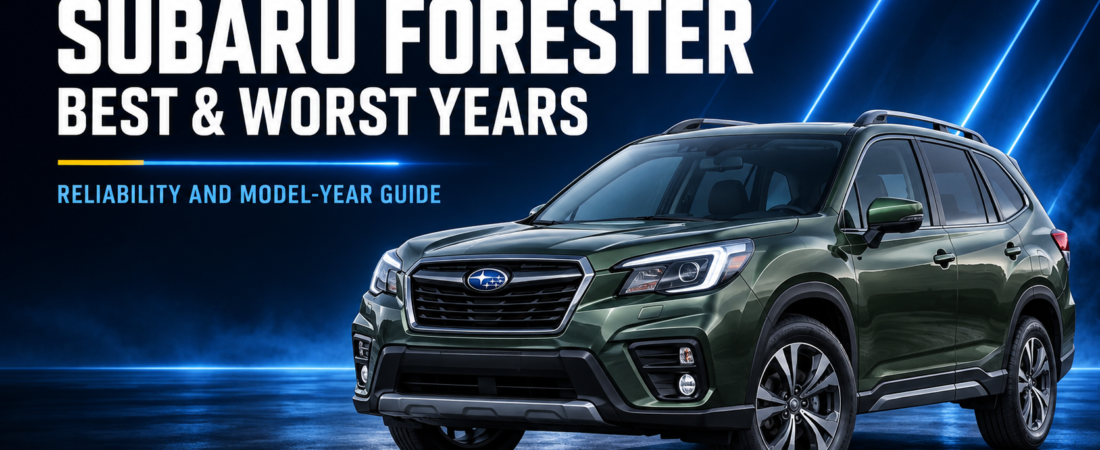
The Subaru Forester has a reputation as the sensible, snow-ready compact SUV that simply keeps going. Standard all-wheel drive, a tall cabin with excellent visibility and strong safety ratings explain why so many used shoppers put it at the top of their list. It debuted for the 1998 model year as one of the first crossover SUVs, and it has been refined through six generations since.
But the Forester’s history is not spotless. Some years are known for head gasket leaks, others for a class-action lawsuit over oil consumption, and a few for CVT complaints. That is why the best years for Subaru Forester are a specific group, not the whole lineup. In this guide, AutoPeeky ranks every model year using owner complaint data from CarComplaints.com, generation research from CarGurus and ownership cost figures from RepairPal. We also answer the questions most Forester shoppers ask: are Subaru Foresters reliable, what do they cost and where are they made.
Before you look at any specific car, run it through our Should I Buy? tool. Enter the year, make and model and you get an instant look at that vehicle’s NHTSA complaint history and open recalls.
Best Years for Subaru Forester at a Glance
Here is AutoPeeky’s ranking for every Forester generation:
| Generation | Best years | Acceptable with checks | Years to avoid |
| First generation (1998-2002) | None | None | 1998 to 2002 |
| Second generation (2003-2008) | 2008 | 2006, 2007 | 2003, 2004, 2005 |
| Third generation (2009-2013) | None | 2010, 2012, 2013 | 2009, 2011 |
| Fourth generation (2014-2018) | None | 2016, 2017, 2018 | 2014, 2015 |
| Fifth generation (2019-2024) | 2021, 2022, 2023, 2024 | 2019, 2020 | None |
| Sixth generation (2025 onward) | Too new to rank | Too new to rank | Too new to rank |
The quick answer: the best years for Subaru Forester are 2021 to 2024, and 2022 is AutoPeeky’s top pick. For a cheaper used Forester, the 2016 to 2018 models are the best value, as long as the CVT has been serviced. The 2008 is the best of the older cars. Avoid the 2014 and 2015, the 2011 and 2009, and any 1998 to 2005 car unless head gasket work is documented.
Subaru Forester Generations and Engines
For a Forester buyer, the engine and transmission often matter more than the badge year, so it helps to know which generation you are looking at.
| Generation | Years | Engines and transmissions | What to know |
| First | 1998 to 2002 | 2.5L boxer (165 hp), manual or 4-speed automatic | Head gasket leaks, rust |
| Second | 2003 to 2008 | 2.5L boxer (165 hp), turbo XT from 2004, manual or 4-speed automatic | Head gasket risk on non-turbo cars |
| Third | 2009 to 2013 | 2.5L boxer (170 hp), turbo XT (224 hp), new 2.5L from 2011 | Head gaskets early, oil consumption 2011 to 2013 |
| Fourth | 2014 to 2018 | 2.5L boxer (170 hp), 2.0L turbo XT (250 hp), Lineartronic CVT | Oil consumption 2014 to 2015, CVT care |
| Fifth | 2019 to 2024 | 2.5L boxer (182 hp), CVT only | Best record, early CVT software issues |
| Sixth | 2025 onward | 2.5L boxer (180 hp), hybrid also offered | New design, little history |
Subaru Forester Best and Worst Years: Early Generations (1998-2008)
First Generation: 1998 to 2002
The original Forester was a pioneering crossover with standard all-wheel drive and 7.5 inches of ground clearance. It was also the start of the Forester’s head gasket reputation. According to CarGurus, the 2.5L non-turbo engine was notorious for head gasket leaks in 1998 to 2002 cars, and many owners replaced the gaskets between 100,000 and 150,000 miles. Rear wheel bearing failures and rust, especially where roads are salted, are also common.
These cars are now more than 24 years old and typically sell for $4,000 to $9,000. We list all five years as years to avoid unless the head gaskets have been replaced and the body is rust-free.
Second Generation: 2003 to 2008
The second-generation Forester was longer, stiffer and safer, and it added the turbocharged XT in 2004. Head gasket failures were less frequent than in the first generation, but they still affected naturally aspirated 2.5L engines. CarComplaints.com lists a head gasket leak as the top problem in 2005, with an average repair cost of around $2,500. XT models can suffer turbo oil supply problems, so oil changes matter.
Our ranking: 2003, 2004 and 2005 are years to avoid unless head gasket work is documented. The 2006 and 2007 are acceptable with checks. The 2008 is the best of the older cars, with just 4 complaints on CarComplaints.com. Prices for this generation run roughly $3,000 to $12,000.
Best Years for Subaru Forester: Third Generation (2009-2013)
The third generation grew into a true compact SUV, with more cargo space and a softer ride. It earned a five-star NHTSA rating and an IIHS Top Safety Pick, and used prices now run about $5,000 to $12,000. The problem is the engines.
2009 and 2010: CarGurus says head gasket failures affected these years. On CarComplaints.com, the 2009 has engine failure listed as one of the Forester’s three worst problems, averaging about $6,300 to fix at roughly 101,000 miles. We rate the 2009 a year to avoid and the 2010 acceptable with a documented head gasket inspection.
2011: Subaru introduced an updated 2.5L with a chain-driven camshaft, but oil consumption became the headline issue. CarComplaints.com lists excessive oil consumption in 2011 as the second worst Forester problem, costing about $3,100 at around 48,000 miles. We rate 2011 a year to avoid.
2012 and 2013: Complaint counts are low (22 for the 2012 and 14 for the 2013), but CarGurus still associates oil consumption with 2011 to 2013 cars. Both are acceptable with checks. Ask for oil change records and whether the engine has been consuming oil between services.
Subaru Forester Best Years: Fourth Generation (2014-2018)
The fourth generation brought a larger cabin, the Lineartronic CVT and, for the first time, Subaru’s EyeSight driver assistance system. EyeSight started as an option and became standard on all models by 2018. This generation is where the Forester’s most complained-about years sit.
2014 and 2015: Years to Avoid
CarComplaints.com rates 2014 as the worst Forester year, even though 2015 has more total complaints (198, against 146 for the 2014). The top problem is high oil consumption in 2014, costing around $2,000 on average and showing up at only about 33,000 miles. CarGurus notes early 2.5L cars from 2014 and 2015 were affected by Subaru’s oil consumption issues, later addressed under warranty. The 2015 also appears near the top of CarComplaints.com’s brake complaint list, and some research sites report CVT and infotainment complaints on early cars in this generation. Skip both years.
2016, 2017 and 2018: The Best Older Value
CarGurus ranks the 2016 to 2018 Foresters among the most highly rated of all. Oil consumption was largely resolved, EyeSight became widely available and used prices run roughly $10,000 to $25,000 for the generation.
We place them in the acceptable column for one reason: the CVT. Complaint counts are 58 for the 2016, 119 for the 2017 and 68 for the 2018, and CarComplaints.com lists the 2018 among Subaru’s more complained-about models. Subaru extended the CVT warranty to 10 years or 100,000 miles on many 2016 to 2018 Foresters, according to service bulletin summaries compiled by CarWhere, so ask a Subaru dealer whether the specific car is covered. Look for documented CVT service and avoid cars that have been driven hard, especially the 250 horsepower XT.
Best Years for Subaru Forester: Fifth Generation (2019-2024)
The 2019 redesign moved the Forester to Subaru’s new global platform, made EyeSight standard and dropped the turbo and manual transmission. It is the most reliable generation overall, with a clear improvement from 2021 onward.
2019 and 2020 (acceptable with checks): Complaint counts are 91 for the 2019 and 44 for the 2020. CarGurus says early cars had minor CVT issues, and Subaru issued CVT software and warranty extensions of up to 10 years or 100,000 miles on 2019 and 2020 Foresters, per CarWhere. A record of CVT fluid changes is important. Some owners also reported wind noise at highway speeds in the early cars.
2021 (best): Only 5 complaints on CarComplaints.com. Steering-responsive LED headlights and high-beam assist reached lower trims, and the CVT concerns of the early cars had settled.
2022 (top pick): A mid-cycle refresh added new styling and the off-road Wilderness trim with 9.2 inches of ground clearance. CarComplaints.com lists just 3 complaints.
2023 and 2024 (best): An updated infotainment screen arrived for 2023, with 3 complaints for 2023 and 2 for 2024. Later facelifted cars from 2022 to 2024 hold higher resale values, so expect to pay more.
Newer cars have had less time to collect complaints, so read those low counts as encouraging rather than conclusive. Used prices for the fifth generation range from about $20,000 to $35,000.
What About the 2025 and Newer Subaru Forester?
The sixth-generation Forester arrived for 2025 with a 2.5L four-cylinder making 180 horsepower, an 11.6-inch touchscreen on most trims and EyeSight on every model. CarGurus lists a starting MSRP of $29,810, rising to $39,995 for the Touring, with a hybrid available from $34,995. It is too new to rank, but it is worth watching for recalls and software updates if you are considering one.
Are Subaru Foresters Reliable?
Yes, with qualifications. RepairPal gives the Forester a reliability rating of 3.5 out of 5, described as above average, but that ranks it 21st out of 26 compact SUVs. RepairPal estimates average annual repair costs of $632, compared with $429 for a Toyota RAV4, with 0.37 shop visits per year and 13% of repairs considered severe.
CarComplaints.com has 1,086 complaints on file, with engine problems the worst category. The most common engine problems cost around $3,800 and show up at about 61,000 miles. The pattern is clear: reliability depends on the year, and the 2021 to 2024 cars are far cleaner than the 2009, 2011, 2014 and 2015.
Subaru Forester Cost: Purchase Price and Ownership
New: CarGurus lists the 2025 Forester starting at $29,810 and the Touring at $39,995, with the hybrid starting at $34,995.
Used: Based on CarGurus figures, typical used prices run about $4,000 to $9,000 for first-generation cars, $3,000 to $12,000 for the second, $5,000 to $12,000 for the third, $10,000 to $25,000 for the fourth and $20,000 to $35,000 for the fifth.
Ownership: RepairPal’s $632 yearly figure is a good starting point, but it varies a lot by year. Put numbers on your decision:
- Use the Used Car Price Estimator as a starting point for negotiation, then cross-check against local listings.
- Run the 5-Year Ownership Cost Calculator with a repair allowance for an older Forester and compare it with a newer one.
- Check fuel costs with the Fuel Cost Calculator, and confirm the exact EPA rating for the engine you are considering.
- Project resale value with the Depreciation Calculator.
- Check your budget with the Car Affordability Calculator and the Monthly Payment Calculator.
Where Are Subaru Foresters Made?
Subaru Foresters sold in the US have been built in Gunma Prefecture, Japan, at Subaru’s Yajima plant. The Ascent, by contrast, is built at Subaru of Indiana Automotive in Lafayette, Indiana. Some dealer sources say certain newer Forester trims are also assembled in Indiana, so the safest way to know where a specific car was built is the VIN. A VIN that begins with JF was built in Japan, while one that begins with 4S was built in Indiana. You can also decode it with our VIN and Recall Check, which also shows open recalls.
Subaru Forester Year-by-Year Summary
| Year | Rating | CarComplaints count | Key notes |
| 1998 to 2002 | Avoid | 1, 14, 11, 23, 10 | Head gasket leaks, rust, wheel bearings |
| 2003 | Avoid | 31 | Head gasket risk |
| 2004 | Avoid | 14 | Head gasket risk, turbo XT oil care |
| 2005 | Avoid | 19 | Head gasket leak averaging $2,500 |
| 2006 | Acceptable | 26 | Check head gaskets |
| 2007 | Acceptable | 20 | Check head gaskets |
| 2008 | Best (older) | 4 | Cleanest of the older cars |
| 2009 | Avoid | 42 | Engine failure, about $6,300 at 101,000 miles |
| 2010 | Acceptable | 46 | Head gasket inspection needed |
| 2011 | Avoid | 52 | Oil consumption, about $3,100 at 48,000 miles |
| 2012 | Acceptable | 22 | Check for oil consumption |
| 2013 | Acceptable | 14 | Check for oil consumption |
| 2014 | Avoid | 146 | Worst year, oil consumption at about 33,000 miles |
| 2015 | Avoid | 198 | Most complaints, oil, brakes, CVT |
| 2016 | Acceptable | 58 | CVT service records, warranty extension |
| 2017 | Acceptable | 119 | Check CVT and electrical |
| 2018 | Acceptable | 68 | EyeSight standard, check CVT |
| 2019 | Acceptable | 91 | Early CVT software issues |
| 2020 | Acceptable | 44 | CVT warranty extension, refined EyeSight |
| 2021 | Best | 5 | Clean record, better headlights |
| 2022 | Best (top pick) | 3 | Refresh, Wilderness trim |
| 2023 | Best | 3 | Updated infotainment |
| 2024 | Best | 2 | Newest and cleanest used option |
How to Check a Used Subaru Forester Before You Buy
- Run the VIN. Use our VIN and Recall Check for live NHTSA recall data. It covers recalls only, not accident or title history.
- Ask for oil change records. On 2011 to 2015 cars, check whether the engine has been consuming oil between changes.
- Check the head gaskets. On any pre-2011 car, look for coolant loss, milky oil or oil seepage where the engine halves meet.
- Ask about CVT service. Request records of CVT fluid changes, and ask a Subaru dealer whether the car is covered by the extended CVT warranty.
- Test drive for hesitation. Listen for shudder, whine or hesitation from the CVT.
- Check for rust. Look at the rear subframe, rocker panels and suspension on cars from salted regions.
- Get an independent inspection from a mechanic who does not work for the seller.
Is the Subaru Forester a Good Car?
Yes, in the right years. Standard all-wheel drive, excellent visibility, strong safety ratings and a roomy cargo area make it one of the best compact SUVs for bad weather. The downsides are a CVT that can feel sluggish, no turbo in the latest generation and a reliability ranking in the lower half of the class.
If you are weighing alternatives, our guide to the best and worst Nissan Rogue years covers the Forester’s closest rival and shows how much the model year matters there too. If you want hybrid efficiency, see the best and worst Toyota Venza years. For a smaller crossover, the best and worst Buick Encore years is another useful comparison.
Other Subaru Years to Avoid: Impreza and Ascent
Many shoppers cross-shop other Subarus, so here is a short summary. It is not a full ranking.
- Subaru Ascent years to avoid: 2019 and 2020. REREV reports the debut 2019 had over 400 NHTSA complaints, and CarWhere lists recalls for missing B-pillar spot welds, a CVT pressure sensor, a PCV valve and fuel pumps on 2019 cars, plus CVT software and warranty extensions for 2019 and 2020. The 2021 and newer cars have much cleaner records.
- Subaru Impreza years to avoid: REREV names 2008, 2012 and 2018 as the most complained-about years, and lists 2005, 2006 and 2015 as other years to avoid. Consumer Reports has also flagged oil consumption on the 2.0L engine in the 2012 and 2013 Impreza.
Conclusion
The best years for Subaru Forester are the 2021, 2022, 2023 and 2024, with 2022 as our top pick. They have the cleanest complaint records, a mature CVT and the most advanced EyeSight technology. If you want to spend less, the 2016, 2017 and 2018 are the best older value, provided the CVT has documented service. The 2008 is the best of the older cars.
Avoid the 2014 and 2015, the 2011 and 2009, and any 1998 to 2005 car unless head gasket work is documented. These rankings come from published data, not hands-on testing, so treat them as a starting point. Before you buy, check the VIN with the VIN and Recall Check, run the exact year through Should I Buy? and get an independent inspection. Have a question about a specific Forester year or trim? Leave it in the comments and the AutoPeeky team will take a look.
Frequently Asked Questions
What are the best years for Subaru Forester?
The best years for Subaru Forester are 2021 to 2024, with 2022 as our top pick. For a cheaper used Forester, the 2016 to 2018 are the best value if the CVT has been serviced, and the 2008 is the best of the older cars.
Which Subaru Forester years should I avoid?
Avoid the 2014 and 2015, which have the highest complaint counts and oil consumption problems, along with the 2011 and 2009. Also avoid any 1998 to 2005 Forester unless the head gaskets have been replaced and documented.
Are Subaru Foresters reliable?
They are above average but not class-leading. RepairPal rates the Forester 3.5 out of 5, which ranks 21st of 26 compact SUVs, with average annual repairs of $632. Reliability depends heavily on the year, and 2021 to 2024 cars have the cleanest records.
Is the Subaru Forester a good car?
Yes. It offers standard all-wheel drive, excellent visibility, high safety ratings and a large cargo area. The main drawbacks are CVT sluggishness and a mixed reliability history in some years.
How much does a Subaru Forester cost?
A new 2025 Forester starts at $29,810 and reaches $39,995 for the Touring, with the hybrid from $34,995. Used prices run from about $3,000 for old second-generation cars to $20,000 to $35,000 for fifth-generation models. Our Used Car Price Estimator can help you judge a specific asking price.
Where are Subaru Foresters made?
Foresters sold in the US have been built in Gunma, Japan, at Subaru’s Yajima plant. Some dealer sources say certain newer trims are also built in Indiana, so check the VIN: JF means Japan and 4S means Indiana.
Do Subaru Foresters have head gasket problems?
Older ones do. Head gasket leaks were common on 1998 to 2010 Foresters with the 2.5L engine, and the 2009 shows engine failure complaints. Later cars moved to different engines and the problem faded, though oil consumption became the main issue on 2011 to 2015 cars.
What should I check before buying a used Subaru Forester?
Run the VIN for recalls, ask for oil change and CVT service records, check for head gasket leaks on older cars, test the CVT for hesitation and have an independent mechanic inspect it. Use the Used Car Price Estimator to check the asking price is fair.