
The Toyota Venza is one of the more unusual stories in the modern SUV world. It launched in 2009 as a stylish crossover wagon that nobody quite knew how to categorize, ran for seven years, got quietly discontinued in 2015, then made a surprise comeback in 2021 as a hybrid-only crossover with a completely different personality.
Two generations. Six years off the market in between. And across that entire timeline, a reliability record that swings from genuinely excellent to unexpectedly frustrating depending entirely on which model year you choose.
That’s exactly the kind of nuance the team at AutoPeeky exists to dig into. We’ve analyzed NHTSA complaint databases, Consumer Reports reliability scores, J.D. Power owner satisfaction data, recall histories, and real-world ownership reviews across every Venza model year to give you one clear, data-backed answer:
Toyota Venza Best and Worst Years . Which are worth buying and which should you walk away from?
Let’s get into it.
Toyota Venza Generations Overview
The Venza has had two very distinct lives:
| Generation | Years | Key Feature |
| 1st Generation (AV10) | 2009–2015 | Crossover wagon, V4 or V6 engine options |
| 2nd Generation (XU80) | 2021–Present | Hybrid-only, 219hp combined, 40 mpg city |
Both generations have their best and worst years. And crucially, both generations follow the same pattern: the early years stumble, the later years shine.
Toyota Venza Best and Worst Years
Here is AutoPeeky complete year-by-year ranking at a glance:
| Generation | ✅ Best Years | ⚠️ Neutral Years | ❌ Worst Years |
| 1st Gen (2009–2015) | 2014, 2015 | 2011, 2012, 2013 | 2009, 2010 |
| 2nd Gen (2021–Present) | 2022, 2023, 2024 | — | 2021 |
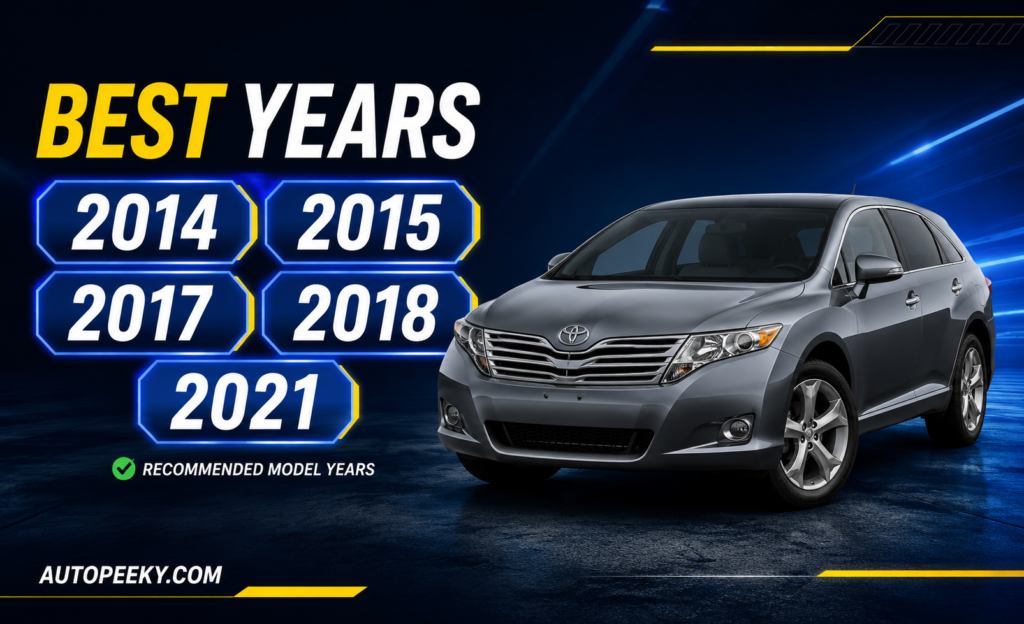
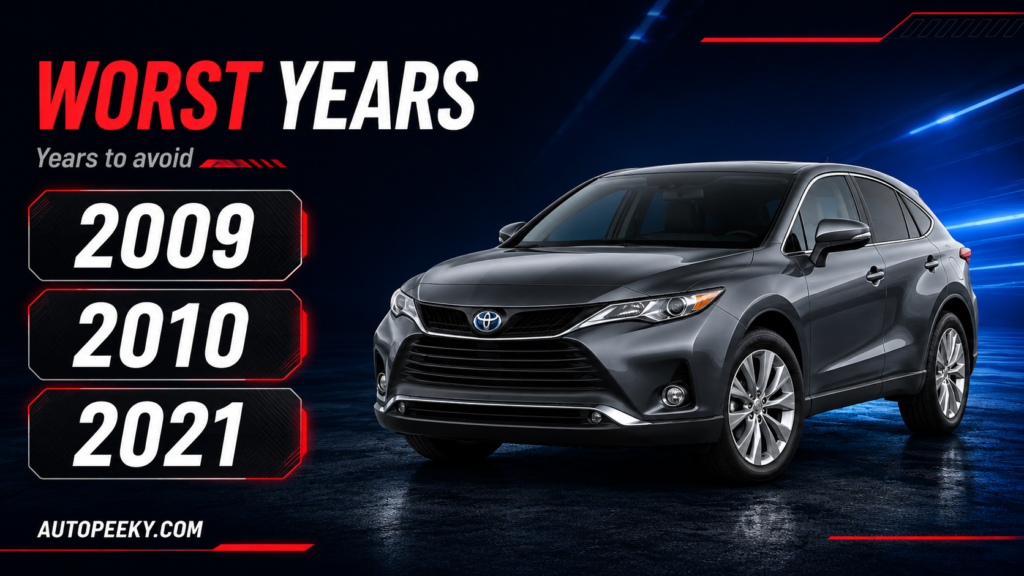
The headline takeaway: avoid the 2009, 2010, and 2021 Venza. Target the 2014, 2015, 2022, 2023, or 2024 for the most dependable ownership experience.
Now let’s go deeper on exactly why.
1st Generation Toyota Venza (2009–2015): Best and Worst Years
When it launched in 2009, the Venza filled an interesting gap. Toyota pitched it at buyers who wanted a raised wagon-like body with available AWD and a more spacious interior than a typical sedan but didn’t need a full body-on-frame SUV. Sales were initially strong, but the early years brought reliability headaches that took several model cycles to fully resolve.
Worst Years: 2009 & 2010 – Toyota Venza Years to Avoid
If there are two years to avoid without hesitation in the entire Venza lineup, it’s the 2009 and 2010. These debut models were working out serious teething problems that no used car buyer should have to inherit.
Electrical system failures were the most pervasive complaint. Owners reported random warning lights, failing accessories, and complete electrical shutdowns problems that frustrated owners and proved difficult for dealers to diagnose consistently.
Powertrain issues were significant in both years. Transmission hesitation, rough shifting behavior, and in some cases outright transmission failures were documented at higher-than-acceptable rates.
Sunroof leaks became notorious among first-generation Venza owners water intrusion through the panoramic roof damaged interior materials and created persistent moisture and mold problems inside the cabin.
Unintended acceleration was among the most serious complaints documented in NHTSA data for these early years, a Toyota-wide issue during this period that affected the Venza’s first generation alongside other models in the lineup.
Brake light failures and jammed gas pedals both triggered recalls on 2009 and 2010 models compounding the reliability concerns into genuine safety issues.
The bottom line: the 2009 and 2010 Venza were first-year products that hadn’t been fully sorted for real-world ownership. NHTSA complaint volumes for both years were among the highest in the model’s history. AutoPeeky strongly recommends skipping both.
Also Read: Best & Worst Jeep Compass Years
Neutral Years: 2011, 2012, 2013
By 2011, Toyota had addressed the most critical first-generation problems and the improvement shows in lower NHTSA complaint volumes and better owner satisfaction scores compared to 2009–2010. But these middle years still carried some baggage.
The 2011 Venza saw complaints around heated seat malfunctions and brake performance that didn’t meet owner expectations. Neither was a safety-critical issue, but both affected quality-of-life in a crossover at this price point.
The 2012 and 2013 Venza were both subject to a recall for potential airbag system concerns, a significant mark against otherwise improving model years. Reliability improved meaningfully in all three years compared to the debut models, but the recall history and lingering complaints kept them out of the recommended column.
These are acceptable used cars if priced appropriately and if you confirm the airbag recall was completed on the specific vehicle you’re considering. But they’re not our top picks when better years are available.
Best Years: 2014 & 2015 – Best Toyota Venza Years (1st Gen)
The 2014 and 2015 Venza models are where the first generation finally delivered on its original promise and they remain the only first-gen years AutoPeeky recommends without reservation.
By 2014, Toyota had ironed out the mechanical and electrical gremlins that plagued the early years. Transmission behavior was smooth and consistent, electrical reliability improved significantly, and the sunroof leak complaints that defined 2009–2010 largely disappeared.
Powertrain options were strong. Buyers could choose between a 2.7L four-cylinder producing 182 horsepower for better fuel economy (around 20 city / 26 highway MPG), or a more muscular 3.5L V6 making 268 horsepower paired with a 6-speed automatic transmission. The V6 in particular delivered a genuinely refined and capable driving experience.
Standard safety equipment covered the essentials well: electronic stability control, traction control, anti-lock brakes with brake assist, and front and side airbag systems across all trim levels.
Trim options LE, XLE, and Limited offered genuine steps up in quality. The Limited trim added heated front seats, a JBL premium audio system, and the panoramic glass moonroof (now properly sealed, unlike early examples). The interior quality of the 2014–2015 Venza punched above its price class.
Owner satisfaction scores on Edmunds, KBB, and Cars.com were among the highest the first generation ever achieved in these final two years. NHTSA complaint volumes were low. These cars age well.
If a first-gen Venza is your target, 2014 or 2015 is the only answer.
Why Was the Venza Discontinued After 2015?
This is a question AutoPeeky hears often, and it’s worth addressing directly.
Toyota discontinued the first-generation Venza after 2015 primarily because of shifting market dynamics rather than reliability problems. By the mid-2010s, traditional crossover wagons were being squeezed from both sides: buyers wanting cargo space were increasingly migrating to dedicated SUVs like the RAV4 and Highlander, while style-focused buyers were turning to car-based crossovers. The Venza’s original niche somewhere between both shrank.
Toyota also recognized that the Venza’s platform was aging and that a proper, modern replacement would require significant investment. Rather than refresh a vehicle with declining sales, they retired it and spent those years developing the thoroughly modern hybrid successor that arrived for 2021.
Read More: Best & Worst Toyota Avalon Years
2nd Generation Toyota Venza (2021–Present): Best and Worst Years
The Venza’s 2021 return was one of Toyota’s more exciting modern product stories. Built on the TNGA-K platform shared with the Camry and RAV4 Hybrid, the new Venza was exclusively hybrid-powered from day one, a clear statement of intent from Toyota about where the model sat in their lineup.
The 2.5L four-cylinder engine works alongside three electric motors to produce a combined 219 horsepower. The electronically controlled CVT (eCVT) delivers seamless acceleration. And the EPA fuel economy numbers 40 city / 37 highway MPG are genuinely class-leading for a non-plug-in mid-size crossover.
But as with the first generation, the debut year stumbled.
Worst Year: 2021 – Toyota Venza Year to Avoid
The 2021 Venza had the right powertrain and the right technology, but it carried first-year build quality issues that gave early buyers serious headaches.
Windshield cracking was the defining problem of the 2021 Venza and it became significant enough to generate a class-action lawsuit. Owners across multiple states reported windshields developing spontaneous cracks without any impact event typically radiating from the edges or appearing after minor temperature changes. Given that windshield replacement on a vehicle with Toyota Safety Sense camera calibration isn’t cheap, this was a costly surprise.
Stability control deactivation on startup was the safety issue that triggered a formal recall: certain 2021 Venza models exhibited a software glitch where the Vehicle Stability Control system would deactivate when the car was first started, leaving the driver without traction management until they manually re-enabled it or restarted the vehicle. On slippery roads, this is a genuine safety concern.
The 2021 Venza’s hybrid powertrain itself was solid; this wasn’t an engine or transmission problem. But the windshield issue and the stability control recall are serious enough to make it a year worth skipping when better options exist at similar price points.
Best Years: 2022, 2023 & 2024 – Best Toyota Venza Years (2nd Gen)
These three years represent the Toyota Venza at its absolute best and they make a compelling case that the second generation is one of the finest hybrid crossovers currently available in the used or new market.
Toyota addressed the 2021 windshield and stability control issues for 2022, and the result was a dramatically cleaner ownership experience. NHTSA complaint volumes for 2022, 2023, and 2024 are very low indicating that the second generation finally hit its stride.
The hybrid system 2.5L four-cylinder plus three electric motors, 219 combined horsepower is silky smooth and impressively efficient. Real-world owners consistently report achieving the EPA’s 40 city / 37 highway figures or better in normal driving conditions. Over a typical 15,000-mile year, this translates to meaningful fuel savings over non-hybrid competitors.
Toyota Safety Sense 2.5 is standard across all trim levels from 2022 forward. This is a comprehensive suite: pre-collision system with pedestrian and cyclist detection, full-speed dynamic radar cruise control, lane departure alert with steering assist, automatic high beams, and lane tracing assist. It’s genuinely advanced active safety technology that competes with anything in the segment.
Interior quality is excellent. The 12.3-inch touchscreen (available on XLE and Limited) runs Toyota’s Multimedia system with wireless Apple CarPlay and Android Auto. The Limited trim adds a stunning panoramic glass roof that can go from clear to opaque electronically, a feature that genuinely impresses passengers. JBL premium audio, a head-up display, and a Digital Rear View Mirror round out a features list that rivals luxury brands.
The 2023 update brought a refreshed multimedia interface, improved connectivity, and minor styling tweaks that kept the Venza feeling current. The 2024 Venza carries these improvements forward with the most current build quality of any Venza ever produced.
Is the Toyota Venza a Good Car?
Yes with context. The Toyota Venza is a genuinely good car in its best model years. The second-generation hybrid powertrain is excellent, fuel economy is class-leading, and Toyota Safety Sense 2.5 is among the best active safety suites available. In the right years particularly 2022–2024 it competes strongly against the Ford Escape Hybrid, Honda CR-V Hybrid, and Subaru Outback.
The first generation is more nuanced: the 2014 and 2015 models are solid, capable vehicles with genuine value in the used market. The early years (2009–2010) are genuinely problematic and best avoided entirely.
Toyota Venza competitors to consider: RAV4 Hybrid, Ford Escape Hybrid, Honda CR-V Hybrid, Hyundai Tucson Hybrid, Subaru Outback.
Toyota Venza Year-by-Year Summary
| Year | Rating | Key Notes |
| 2009 | ❌ Avoid | Electrical failures, unintended acceleration, multiple recalls |
| 2010 | ❌ Avoid | Sunroof leaks, transmission issues, brake light recall |
| 2011 | ⚠️ Neutral | Improved but heated seat & brake complaints persist |
| 2012 | ⚠️ Neutral | Airbag recall, acceptable overall reliability |
| 2013 | ⚠️ Neutral | Continued airbag recall concerns, incremental improvements |
| 2014 | ✅ Best | Most reliable 1st gen — sorted powertrain, high owner satisfaction |
| 2015 | ✅ Best | Best 1st gen year overall — refined, reliable, well-equipped |
| 2021 | ❌ Avoid | Windshield cracking issue, VSC recall, first-year faults |
| 2022 | ✅ Best | Issues resolved, low complaints, excellent hybrid efficiency |
| 2023 | ✅ Best | Updated tech, TSS 2.5 standard, strong reliability data |
| 2024 | ✅ Best | Most current build quality, best-equipped Venza ever made |
Toyota Venza Reliability: What the Data Says
Overall, the Toyota Venza lands in the above-average reliability tier when you look at the model as a whole but that average masks huge variation between years.
Consumer Reports gives the 2022–2024 Venza strong reliability scores, specifically praising the hybrid powertrain’s durability and the low incidence of owner-reported problems. J.D. Power rated 2023 Venza owner satisfaction highly in its Vehicle Dependability Study.
The first-generation 2014 and 2015 models similarly score well on long-term reliability once the early-generation problems are filtered out.
The weak spots 2009, 2010, and 2021 drag the model’s aggregate scores down. Avoid those years, and you’re looking at a reliably reliable vehicle.
Conclusion
The Toyota Venza has quietly become one of the more interesting hybrid crossovers in the used car market but only if you choose the right year. Pick the wrong one, and you’re inheriting problems that Toyota should have solved before delivering the car to the first owner.
Buy the 2022, 2023, or 2024 for the best overall Venza experience. If first-gen prices work better for your budget, then 2015 or 2014 are the only years worth considering. In every case, skip the 2009, 2010, and 2021 their documented issues simply aren’t worth the risk when better alternatives exist within the same model line.
Check the VIN at NHTSA.gov, confirm all recalls are closed, get an independent inspection, and you’ll be well on your way to one of Toyota’s most underrated vehicles.
FAQ’s
Which Toyota Venza year is best to buy?
The best Toyota Venza year overall is 2022. It combines the thoroughly resolved second-generation hybrid powertrain with fixed first-year issues, Toyota Safety Sense 2.5 as standard, and class-leading fuel economy. If the budget allows for newer, 2023 and 2024 are equally excellent. For first-generation buyers, the 2015 is the top recommendation.
What Toyota Venza years should I avoid?
The Toyota Venza years to avoid are 2009, 2010, and 2021. The 2009 and 2010 had serious electrical failures, powertrain issues, and multiple safety recalls. The 2021 second-generation debut suffered from a widespread windshield cracking problem and a stability control software recall.
Are Toyota Venzas good cars?
Yes particularly the 2022–2024 hybrid models and the 2014–2015 first-generation models. The second-gen Venza’s hybrid powertrain is smooth, efficient (40 mpg city), and durable. Toyota Safety Sense 2.5 is standard across all trims. In the right model years, the Venza is one of the better hybrid crossovers on the market.
Is the Toyota Venza reliable long-term?
The 2014, 2015, and 2022–2024 Venza models have demonstrated strong long-term reliability. Toyota’s hybrid systems used in the Prius and RAV4 Hybrid with proven track records underpin the second-gen Venza, lending confidence to its longevity. With proper maintenance, a well-bought Venza should comfortably exceed 200,000 miles.
Why was the Toyota Venza discontinued?
Toyota discontinued the Venza after 2015 due to declining sales in a shifting market buyers were increasingly choosing dedicated SUVs like the RAV4 or Highlander over the Venza’s crossover-wagon formula. Toyota brought it back for 2021 as a hybrid-only product with a clearly modernized identity.
How does the Toyota Venza compare to the RAV4 Hybrid?
The Venza and RAV4 Hybrid share similar platforms and powertrains, but target slightly different buyers. The Venza prioritizes a more car-like, premium feel with better fuel economy (40 vs. 38 city mpg), while the RAV4 Hybrid offers more cargo space and more off-road-ready variant options. Both are excellent vehicles; the choice comes down to lifestyle needs.
What should I check before buying a used Toyota Venza?
Before buying any used Venza, check: (1) recall completion status via NHTSA.gov using the specific VIN; (2) for 2009–2013 models, confirm the airbag recall was completed; (3) for 2021 models, inspect the windshield carefully and confirm the VSC recall fix was applied; (4) full maintenance records particularly oil change frequency on the first-gen models; (5) a test drive checking for any transmission hesitation or electrical warning lights.