
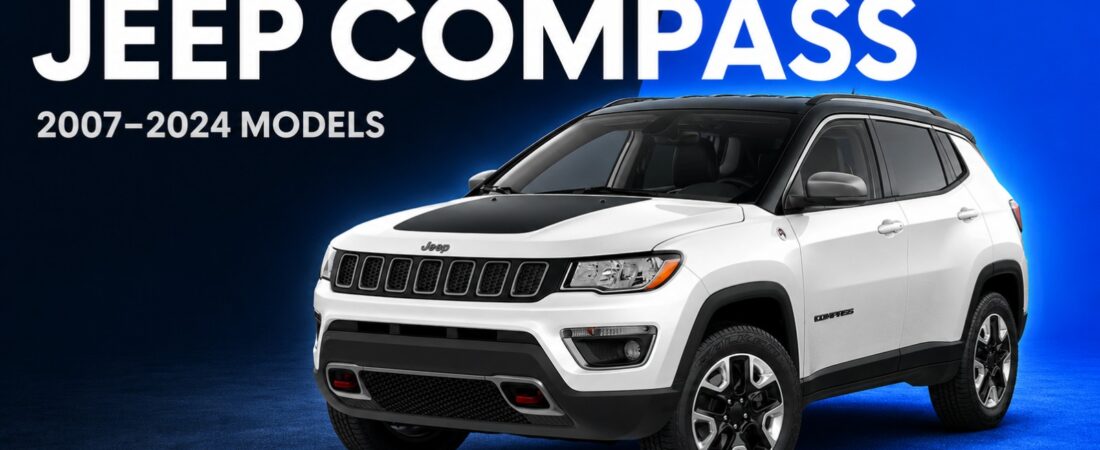
The Jeep Compass has always been a tempting buy. Rugged looks, available 4WD, Jeep badge credibility and a price tag that makes it accessible to a wide range of buyers. On paper, it checks a lot of boxes for compact SUV shoppers.
The gap between the best and worst Jeep Compass years isn’t small, it’s significant. And if you don’t know which Best & Worst Jeep Compass Years to Buy and Avoid, you could end up paying used-car money for a very expensive headache.
That’s exactly why the team at AutoPeeky built this guide. We’ve dug through NHTSA complaint databases, Consumer Reports reliability scores, J.D. Power owner satisfaction data, recall histories, and thousands of real owner reviews to give you a straight, no-spin answer to the question every used Compass shopper needs answered:
What year Jeep Compass should you avoid and what year should you actually buy?
Let’s break it all down.
Jeep Compass Generations: A Quick Overview
Before we get into specific years, it helps to understand how the Compass evolved. There have been two distinct generations and they’re very different vehicles.
| Generation | Years | Platform |
| 1st Generation (MK49) | 2007–2017 | Chrysler PM platform |
| 2nd Generation (MP/552) | 2018–Present | Fiat Small Wide 4×4 |
The first generation had a long, turbulent run 11 years during which Jeep slowly ironed out the early kinks, though some years remained deeply problematic throughout. The second generation arrived in 2018 with a complete redesign but, true to Jeep form, stumbled out of the gate before settling into a more dependable rhythm.
Knowing which generation you’re shopping for is the starting point. From there, model year matters enormously.
Jeep Compass Best & Worst Years at a Glance
Here is AutoPeeky full year-by-year ranking at a glance before we go deeper into the details:
| Generation | ✅ Best Years | ⚠️ Neutral Years | ❌ Worst Years |
| 1st Gen (2007–2017) | 2013, 2015 | 2009, 2010, 2016, 2017 | 2007, 2008, 2011, 2012, 2014 |
| 2nd Gen (2018–Present) | 2020, 2021, 2023, 2024 | — | 2018, 2019, 2022 |
The short answer: Avoid the 2007–2008, 2011–2012, 2014, 2018–2019, and 2022 model years. Target the 2013, 2015, 2020, 2021, 2023, or 2024 for the most dependable experience.
1st Generation Jeep Compass (2007–2017): Best & Worst Years
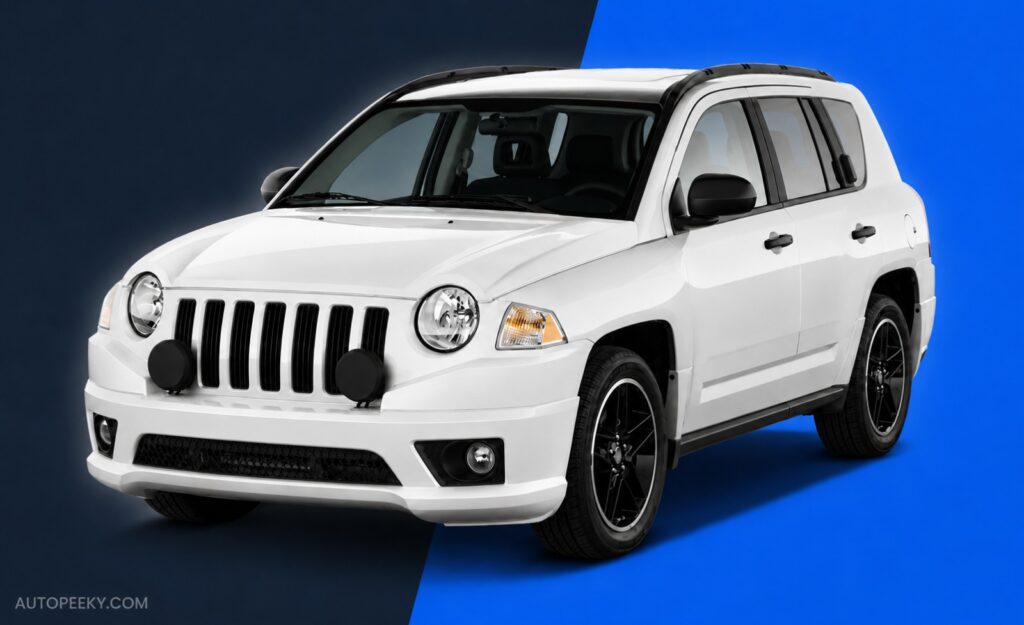
The original Compass debuted as Jeep’s answer to growing demand for affordable compact crossovers. It borrowed heavily from the Jeep Patriot’s architecture and shared its GKN-sourced drivetrain. The early years were rough. Very rough. But by the time the first generation wrapped up in 2017, Jeep had mostly though never fully gotten the formula right.
Worst Years: 2007 & 2008 – Jeep Compass Years to Avoid
The debut years of the first-generation Compass are, without question, the worst place to start your used car search. If there are two years to avoid with absolute certainty, it’s these.
Transmission failure was the defining problem. The CVT (Continuously Variable Transmission) fitted to early Compass models was notoriously unreliable, prone to overheating, slipping, shuddering, and in many cases failing outright, often before the vehicle reached 60,000 miles. Replacing a CVT is not a cheap repair.
ABS control module software defects caused rear brakes to lock up unexpectedly, a serious safety hazard that led to a significant NHTSA recall. The issue made emergency stops unpredictable and dangerous.
Acceleration pedal stiffness was another documented complaint, with drivers struggling to modulate throttle input particularly dangerous in traffic.
Subframe corrosion began appearing on these early cars in rust-belt states. The subframe supports the suspension and steering corrosion. There isn’t just cosmetic damage, it’s a structural safety concern.
NHTSA complaint volumes for the 2007 and 2008 Compass remain among the highest for the entire model’s history. These cars represent an era when Jeep hadn’t properly sorted the Compass for real-world ownership.
Bottom line: The 2007 and 2008 Jeep Compass are the definitive years to avoid.
Worst Years: 2011 & 2012 – Jeep Compass Years to Avoid
After modest improvements in 2009 and 2010, the Compass fell back into troubled territory with the 2011 and 2012 model years.
CVT overheating made a dramatic return as the top owner complained. The transmission would overheat under normal driving conditions not just aggressive or towing use causing the engine to rev wildly while the car barely moved. It was as alarming as it sounds, and left many owners stranded.
When the CVT overheated, it often triggered sudden power steering loss as the engine management system struggled to cope. Losing power steering while navigating traffic is a frightening experience.
Fuel tank transfer tube failures caused fuel system faults and engine stalling a problem significant enough to trigger a NHTSA recall. The faulty tubes could crack and leak, creating both a driveability and a safety hazard.
Airbag system recalls affected both years, with concerns around proper deployment in certain crash scenarios.
Subframe corrosion remained an issue, particularly in northern states where road salt accelerated metal degradation.
The 2011 and 2012 models represent a failure by Jeep to address known issues from earlier years making them doubly frustrating for owners who expected improvement.
Worst Year: 2014 – Jeep Compass Year to Avoid
The 2014 Compass appeared to be a recovery year on the surface a mid-cycle refresh brought minor styling updates and some new features. But under the skin, owners experienced a troubling cluster of new problems.
Occupant Restraint Control (ORC) module short circuits triggered a major recall affecting the airbag and seat belt pre-tensioner systems. A short-circuiting ORC module could cause airbags to deploy unexpectedly or fail to deploy when needed. Both outcomes are unacceptable from a safety standpoint.
Electronic throttle body failures caused sudden, unexpected engine stalling sometimes at highway speeds. This problem generated significant owner frustration and a high NHTSA complaint rate.
Electrical system faults were widespread in 2014, with owners reporting warning lights illuminating randomly, accessory systems failing, and in some cases complete electrical shutdowns.
Engine stalling due to fuel system failures returned as a theme, with multiple complaints about the vehicle dying without warning in traffic.
The 2014 Compass carries one of the poorest reliability records of its generation. Skip it.
Neutral Years: 2009 & 2010
The 2009 and 2010 Compass models reflected Jeep’s early attempts to address first-generation problems. Complaint volumes dropped compared to 2007–2008, and some CVT improvements reduced (but didn’t eliminate) transmission-related issues.
Subframe corrosion remained a documented concern particularly on cars in northern states. This is a non-negotiable inspection item for any 2009–2010 Compass purchase.
These years are acceptable if priced right and if you can confirm a full, clean inspection — but they’re not our recommended buys.
Neutral Years: 2016 & 2017
The final years of the first generation brought the most refined version of the original Compass, with notable improvements to interior quality, technology, and ride refinement. But they weren’t problem-free.
Engine stalling in 2016 was the standout issue specifically tied to camshaft position sensor failures that triggered unexpected shutdowns. Jeep issued a recall to address the sensor, but complaint volumes were elevated before it was resolved.
The 2016 infotainment system was a source of persistent frustration, with owners reporting frequent software crashes, unresponsive touchscreens, and connectivity failures that were difficult to remedy.
The 2017 Compass saw ongoing infotainment complaints and added halfshaft disengagement issues in 6-speed transmissions, a mechanical concern that led to a recall. Dashboard panel lighting failures also prompted separate recall action.
Best Years: 2013 & 2015 – Best Jeep Compass Years (1st Gen)
If you’re shopping for a first-generation Jeep Compass, these are the two model years worth your attention.
The 2013 Compass represented a genuine turning point for the first generation. Jeep’s engineers made significant calibration improvements to the CVT transmission that dramatically reduced overheating and failure complaints, the problem that had plagued 2011 and 2012 so severely. The result was a noticeably more reliable ownership experience.
Engine options included the 2.0L I4 and the more capable 2.4L I4, the larger engine being the recommended choice for anything beyond basic city driving. Fuel economy was a respectable 23 city / 28 highway MPG in FWD form.
The 2013 also brought meaningful infotainment and connectivity improvements, along with better safety features including upgraded airbag systems and stability control.
The 2015 Compass built on everything the 2013 got right. Transmission reliability continued to improve, complaint volumes remained relatively low, and owner satisfaction scores on both Edmunds and KBB were among the best the first generation ever achieved.
The 2015 added refinements to the interior and kept the solid 2.4L powertrain option. Fuel economy figures were identical to 2013. From a used-car standpoint, these are the first-gen years where you get Jeep Compass capability without the legacy reliability baggage.
AutoPeeky recommendation: If budget requires a first-gen Compass, the 2013 or 2015 are the only years worth considering.
Also Read about: Best & Worst Toyota Avalon Years
2nd Generation Jeep Compass (2018–Present): Best & Worst Years
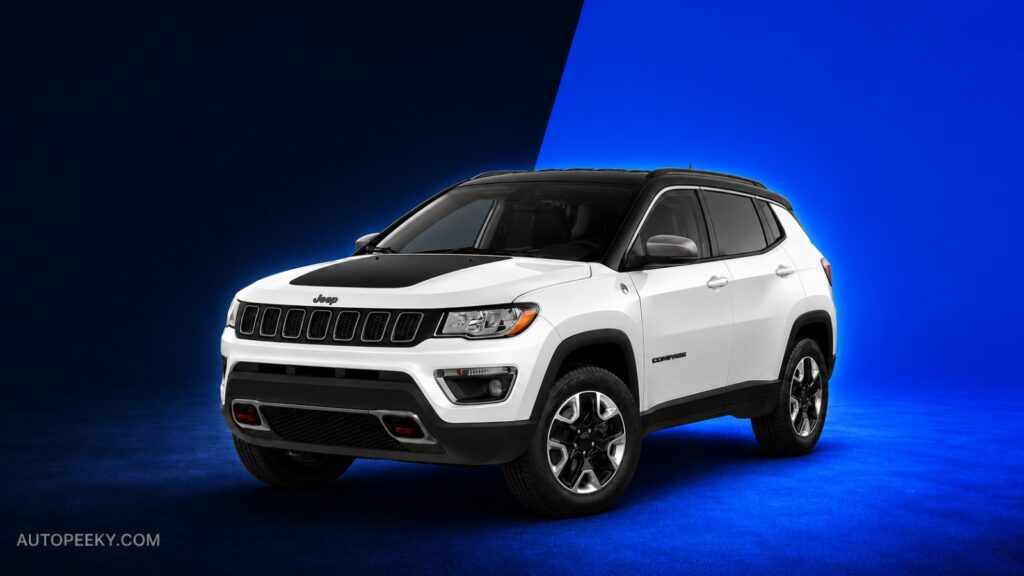
The second-generation Compass arrived for 2018 as a complete ground-up redesign. Built on Fiat Chrysler’s Small Wide 4×4 platform, it was a genuinely modern vehicle, better looking, better built, better equipped. European markets got it first, and the early signs were encouraging.
Then reality hit.
Worst Years: 2018 & 2019 Jeep Compass Years to Avoid
The 2018 debut year of the new-generation Compass became a case study in why first-model-year buying is risky. Despite the improved platform and design, the 2018 Compass arrived with an alarming number of serious faults.
Voltage regulator failures caused the electrical system to malfunction, leading to unexpected engine stalling, a recall-level safety problem. An engine stalling at highway speed is never acceptable.
Lower control arm separation was perhaps the most alarming issue: a structural component of the front suspension could separate while driving, causing sudden loss of vehicle control. Jeep issued a recall, but this type of defect erodes confidence in the vehicle’s fundamental build quality.
Rear brake caliper piston coating defects caused brake performance degradation less stopping power, precisely when you need reliability most.
Infotainment system failures were among the most common owner complaints: radio screens going blank, Uconnect software crashing repeatedly, and random warning light illumination that dealers struggled to diagnose.
Instrument panel illumination failures triggered a separate recall; drivers couldn’t properly read their gauges in low-light conditions.
The 2019 Compass was marginally better than 2018, but many of the same electrical system and infotainment complaints persisted. Engine and transmission reliability improved over 2018, but the Uconnect system remained a consistent frustration for owners. NHTSA complaint volumes for 2019, while lower than 2018, were still above acceptable levels.
Neither the 2018 nor the 2019 Compass earns a recommendation from AutoPeeky.
Worst Year: 2022 – Jeep Compass Year to Avoid
The 2022 Compass is an outlier; it sits between otherwise well-regarded years, and its problems are narrower in scope than the worst first-generation years. But they’re significant enough to earn an avoid rating.
Forward collision warning system malfunctions were the primary complaint: the system would trigger false alerts, startling drivers with emergency warnings for obstacles that didn’t exist. This kind of false positive quickly trains drivers to ignore safety alerts, defeating the purpose entirely.
Auto-dim mirror failures were a widely reported problem, along with recurring infotainment and electrical glitches that Jeep hadn’t fully resolved from earlier years.
Instrument panel illumination failures returned as an issue, triggering yet another recall of the same category of problem that affected 2018 models years earlier.
The 2022 is worth skipping in favor of the cleaner 2021 or 2023 options that sit on either side of it.
Best Years: 2020, 2021, 2023, 2024 – Best Jeep Compass Years
These four years represent the Jeep Compass at its best where the second generation finally delivered on the promise of its redesign.
The 2020 Compass was the breakthrough year of the second generation. Jeep had addressed the critical electrical and structural issues that plagued 2018 and 2019. The 2.4L I4 engine paired with the 9-speed automatic (4WD models) delivered smooth, capable performance, and fuel economy improved to a competitive 22 city / 31 highway MPG.
Safety features made a significant leap: lane departure warning, blind-spot monitoring, rear cross-traffic alert, and automatic emergency braking became available across more trim levels. The Uconnect infotainment system was more stable and better-resolved than in any previous year.
The 2021 Compass continued the 2020’s improvements with minor refinements. Owner satisfaction scores on Edmunds, Cars.com, and KBB all ranked 2021 among the top Compass years ever. NHTSA complaint volumes were low. This is a very clean used car buy.
The 2023 Compass received a significant update: the 2.4L engine was replaced with a new turbocharged 2.0L I4 paired with an 8-speed automatic transmission and standard 4WD. Fuel economy improved to 24 city / 32 highway MPG. Standard safety equipment expanded, and the interior received meaningful quality upgrades. Early reliability data is strong.
The 2024 Compass carries forward the 2023’s improvements with continued refinements. As the newest model year, it benefits from the most current engineering and parts quality. If the budget allows for a near-new or certified pre-owned option, 2024 is the top-of-range recommendation.
Jeep Compass Latitude Years to Avoid
The Latitude is the most popular trim level in the Compass lineup and the one most used car shoppers encounter. The good news: the Latitude is available across nearly all model years, which means the year-based guidance above applies directly.
Jeep Compass Latitude years to avoid: 2007, 2008, 2011, 2012, 2014, 2018, 2019, and 2022. The same issues that plagued base Sport trims in these years affected the Latitude equally; the trim level doesn’t insulate you from the platform-level mechanical and electrical problems documented above.
Best Jeep Compass Latitude years to buy: 2013, 2015, 2020, 2021, 2023, and 2024. The 2021 Latitude in particular offers an excellent balance of features, reliability, and used-market pricing.
Common Jeep Compass Problems to Watch For
No matter which year you’re considering, these are the recurring problems AutoPeeky flagged across the Compass’s full history. Inspect for these before buying any used Compass:
1. CVT Transmission Overheating (2007–2012 especially) The most catastrophic single failure mode in early Compass history. If you’re looking at a pre-2013 Compass with a CVT, get a thorough transmission inspection and request full service history. CVT replacement costs range from $3,000–$5,000+.
2. Subframe Corrosion (2007–2015, northern states) The subframe sits at the base of the suspension and steering system. Significant corrosion here is both a safety risk and an expensive repair. Any purchase of a first-gen Compass from a rust-belt state must include an undercarriage inspection.
3. Engine Stalling (Multiple years) Multiple root causes across different years camshaft position sensors, fuel system failures, throttle body faults, and voltage regulator failures all caused unexpected stalling. Test drive extensively and check for any stored fault codes before purchase.
4. Infotainment System Failures (2016–2022) The Uconnect system across various Compass generations has a well-documented history of software crashes, unresponsive screens, and connectivity failures. Check for software updates and test the system thoroughly on a test drive.
5. Airbag & Safety System Recalls (Multiple years) The Compass has been subject to multiple airbag-related recalls across its history, including Occupant Restraint Control module faults and Takata airbag concerns. Always verify the full VIN recall history at NHTSA.gov before completing any purchase.
6. Electrical System Gremlins (2014, 2018–2022) Random warning lights, accessory failures, instrument panel illumination loss, and voltage regulation issues have been documented across multiple years. Have a technician scan for stored codes and check for any unresolved TSBs.
AutoPeeky Top Pick: The Best Jeep Compass Year to Buy
After reviewing every year from 2007 through 2024, here is AutoPeeky’s verdict:
The 2021 Jeep Compass is the best used buy in the model’s entire history.
Here’s why the 2021 stands above everything else:
- All of the 2018–2019 second-gen problems had been thoroughly resolved
- Strong 2.4L I4 + 9-speed automatic powertrain smooth and capable
- Comprehensive driver assistance tech available (lane departure, AEB, blind spot)
- 22 city / 31 highway MPG competitive in the compact SUV class
- Among the lowest NHTSA complaint volumes in the Compass’s history
- Top owner satisfaction scores across Edmunds, KBB, and Cars.com
- Available in all trim levels including the popular Latitude and Trailhawk
If you’re shopping newer, the 2023 Compass is an excellent alternative; the new turbo engine and updated tech make it a compelling step up, and it’s now appearing in the used and CPO market at accessible prices.
For first-generation shoppers on a tighter budget, the 2015 Compass is the safest choice, the most refined and reliable first-gen model year, available at attractive prices in the used market.
Jeep Compass Year-by-Year Summary
| Year | Rating | Key Notes |
| 2007 | ❌ Avoid | CVT failure, ABS recall, brake lock-up risk |
| 2008 | ❌ Avoid | CVT problems, stiff throttle, subframe corrosion |
| 2009 | ⚠️ Neutral | Improvements made, subframe corrosion persists |
| 2010 | ⚠️ Neutral | Incremental improvement, still inspect undercarriage |
| 2011 | ❌ Avoid | CVT overheating, fuel system recall, airbag recall |
| 2012 | ❌ Avoid | CVT stalling, power steering loss, safety recalls |
| 2013 | ✅ Best | CVT resolved, solid reliability, great used buy |
| 2014 | ❌ Avoid | ORC module recall, throttle body stalling, electrical faults |
| 2015 | ✅ Best | Most reliable 1st gen year, strong owner satisfaction |
| 2016 | ⚠️ Neutral | Camshaft sensor recall, infotainment issues |
| 2017 | ⚠️ Neutral | Halfshaft recall, electrical/infotainment complaints |
| 2018 | ❌ Avoid | Control arm recall, voltage failures, brake defects |
| 2019 | ❌ Avoid | Ongoing electrical/infotainment issues, elevated complaints |
| 2020 | ✅ Best | 2nd gen sorted, strong reliability, great features |
| 2021 | ✅ Best | AutoPeeky’s top pick — best Compass year overall |
| 2022 | ❌ Avoid | FCW false alerts, auto-dim failures, instrument recall |
| 2023 | ✅ Best | New turbo engine, updated tech, strong early data |
| 2024 | ✅ Best | Most current, best-equipped, near-new option |
FAQ’s
What year Jeep Compass should I avoid?
The Jeep Compass years to avoid are 2007, 2008, 2011, 2012, 2014, 2018, 2019, and 2022. These model years have the highest documented rates of NHTSA complaints, safety recalls, mechanical failures, and owner dissatisfaction. The 2007–2008 and 2011–2012 first-generation years are particularly problematic due to CVT transmission failures. Among second-generation models, 2018 is the single worst year to buy.
What are the best Jeep Compass years to buy?
The best Jeep Compass years are 2013, 2015, 2020, 2021, 2023, and 2024. The 2021 Compass is AutoPeeky’s top recommended used car but overall it combines resolved mechanical issues, strong reliability data, full driver assistance technology, and competitive fuel economy. For first-gen buyers, the 2015 is the safest choice.
Is the Jeep Compass Latitude reliable?
The Jeep Compass Latitude’s reliability depends entirely on the model year. In good years like 2021 and 2015, the Latitude trim is a solid, dependable vehicle. In problematic years like 2018, 2011, and 2007, even the Latitude trim suffers from the same platform-level issues affecting all Compass trims. The trim level does not insulate you from year-specific problems.
What is the most common problem with the Jeep Compass?
The most persistent and costly Jeep Compass problem is CVT transmission failure, predominantly in the 2007–2012 model years. Engine stalling is the second most documented issue appearing across multiple generations caused by different root failures including CVT overheating, fuel system faults, camshaft sensor failures, and voltage regulator defects. Infotainment system malfunctions are the top complaint in second-generation models (2016–2022).
Is the Jeep Compass a good used car buy?
The Jeep Compass can be an excellent used car buy but only in the right model year. The 2020 and 2021 second-generation Compass models offer a genuinely good combination of capability, features, and reliability. The 2013 and 2015 first-generation models also hold up well. Avoid the problematic years listed in this guide, and the Compass offers solid value for compact SUV buyers.
How many miles will a Jeep Compass last?
A well-maintained Jeep Compass can reach 150,000–200,000 miles. The key phrase is “well-maintained.” First-generation Compass models with CVT transmissions require especially meticulous maintenance neglecting transmission fluid changes that dramatically reduces lifespan. Second-generation models with conventional automatic transmissions are generally more durable long-term.