
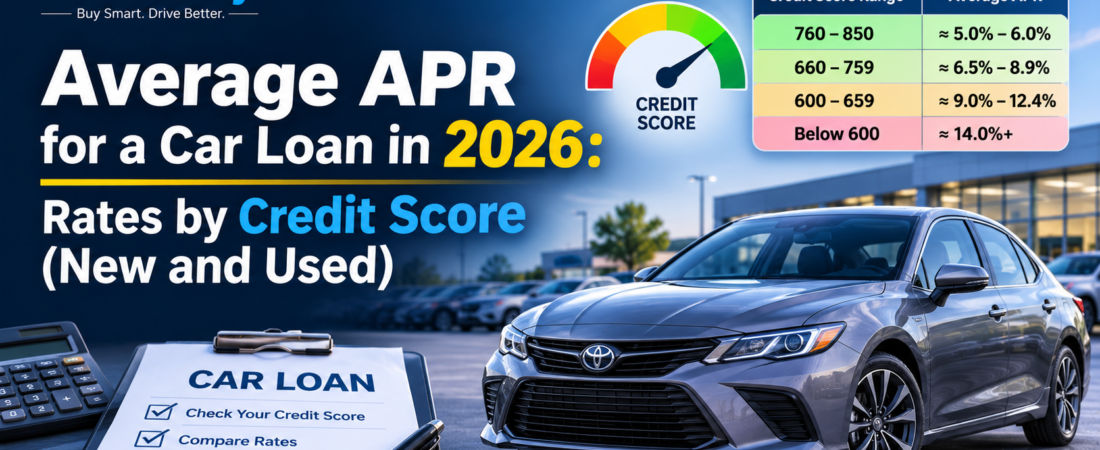
If you are financing a car, one number will shape what you pay more than almost any other: the APR. In the second quarter of 2026, the average APR for a car loan was 6.35% for new cars and 11.19% for used cars, according to Experian’s State of the Automotive Finance Market data. But those averages hide a huge range. A new car buyer with excellent credit averaged 4.41%, while a deep subprime borrower averaged 16.11%.
This guide answers the questions shoppers ask most: what is an APR for a car loan, what is a good or ideal APR, what are current car loan rates and used car loan rates by credit score, and how can you get a lower rate. We also show how much a few percentage points change your monthly payment and total interest, so you can see why shopping for the rate matters as much as shopping for the car.
AutoPeeky is not a lender or a financial advisor. The figures below are national averages, so confirm your actual rate and terms with lenders before you sign anything.
What Is an APR for a Car Loan?
APR stands for annual percentage rate. On a car loan, it is the yearly cost of borrowing, expressed as a percentage. The Consumer Financial Protection Bureau explains the difference clearly: a loan’s interest rate is the cost you pay the lender for borrowing money, while the APR is the interest rate plus any additional fees the lender charges, including origination charges and other fees at the time the loan is made.
A few points worth knowing:
- If a loan has no fees, the APR and the interest rate are the same. If it has fees, the APR will be higher.
- Under the federal Truth in Lending Act, lenders must give you the APR before you finalize the loan, so you can use it to compare offers.
- Compare APR to APR. Do not compare one lender’s APR with another lender’s plain interest rate, because they are not the same measure.
In everyday shopping, when people ask “what is an APR for a car” or “what is an APR rate for a car,” this is the number they mean: the all-in yearly price of the loan.
What Is the Average APR for a Car Loan Right Now?
Here are the latest averages from Experian’s second quarter 2026 data:
| Loan type | Average APR | Average credit score | Average loan amount | Average term | Average monthly payment |
| New car | 6.35% | 751 | $43,610 | 69.5 months | $765 |
| Used car | 11.19% | 688 | $27,852 | 67.9 months | $542 |
Used car loan rates are nearly double new car rates. Part of the reason is the borrowers: the average used car buyer has a lower credit score than the average new car buyer. Part is the vehicle. Older cars with more miles are riskier for lenders, and many lenders may not finance a car older than 10 years or with more than 100,000 miles.
Rates have also been moving. Experian’s news roundup, citing Edmunds, reports that after the Federal Reserve’s September rate hike, average auto loan APRs rose in October to 7.3% for new cars and 11% for used cars, up from 7.1% and 10.7% a month earlier. Averages from different sources differ slightly because they use different data and time periods, so treat any single figure as a benchmark rather than a quote.
Car Loan Rates by Credit Score
Your credit score is the single biggest factor in your APR. These are Experian’s Q2 2026 averages by credit tier:
| Credit tier | Score range | New car APR | New car payment | Used car APR | Used car payment |
| Super prime | 781 to 850 | 4.41% | $741 | 6.29% | $534 |
| Prime | 661 to 780 | 6.15% | $770 | 8.81% | $528 |
| Near prime | 601 to 660 | 9.71% | $816 | 13.93% | $555 |
| Subprime | 501 to 600 | 13.52% | $805 | 19.10% | $567 |
| Deep subprime | 300 to 500 | 16.11% | $779 | 21.62% | $570 |
The gap between the best and worst new car tiers is 11.7 percentage points. For used cars it is 15.3 points. Notice that monthly payments do not rise as steeply as rates, because buyers with weaker credit tend to borrow less. The real cost shows up in total interest, which we calculate below.
What Is a Good APR for a Car Loan?
There is no single ideal APR for a car loan, because the right number depends on your credit and the car. A practical rule is that a good APR is at or below the average for your credit tier. From the table above:
- Super prime credit (781 and up): around 4.4% for a new car and 6.3% for a used car is typical.
- Prime credit (661 to 780): around 6.2% new and 8.8% used.
- Near prime credit (601 to 660): around 9.7% new and 13.9% used.
If you are offered a rate noticeably above your tier’s average, that is a signal to shop around. The CFPB notes that dealers and lenders are not required to offer you the best available rate. Manufacturers also sometimes offer promotional rates on select new models, which can beat these averages, but those offers usually require strong credit and may come with other trade-offs, so compare them with a preapproved bank or credit union rate.
How Much Does APR Change Your Payment?
A few percentage points sound small. They are not. Here is what a $30,000 loan over 60 months costs at different APRs (our own calculations, rounded):
| APR | Monthly payment | Total interest |
| 4.41% | $558 | $3,484 |
| 6.15% | $582 | $4,925 |
| 8.81% | $620 | $7,199 |
| 9.71% | $633 | $7,988 |
| 11.19% | $655 | $9,307 |
| 13.93% | $697 | $11,818 |
| 19.10% | $780 | $16,792 |
On the same $30,000, the difference between the 4.41% and 19.10% borrower is about $13,300 in interest. You can run your own numbers with our Monthly Payment Calculator: enter the vehicle price, down payment, trade-in value, sales tax, APR and loan term to see your monthly payment, total interest and total cost.
The loan term matters too. Here is the same $30,000 at the new car average of 6.35%:
| Term | Monthly payment | Total interest |
| 48 months | $709 | $4,050 |
| 60 months | $585 | $5,093 |
| 72 months | $502 | $6,155 |
| 84 months | $443 | $7,238 |
A longer term lowers the payment but raises the total interest, and longer loans also leave you owing more than the car is worth for longer. Experian notes that shorter terms often qualify for lower rates as well.
Used Car Loan Rates: What to Expect
Used car loan rates run higher, and they climb faster as credit drops. With super prime credit, the used average is 6.29%, and with prime credit it is 8.81%. Below that, rates pass 13% and can exceed 21%.
A few things work in your favor on a used car. The average loan is smaller ($27,852 versus $43,610 for new), so the dollar cost of a higher rate is partly offset. You also avoid the steepest early depreciation. To see how a specific car’s value is likely to change, use the Depreciation Calculator, and check an asking price with the Used Car Price Estimator, which gives a depreciation-based estimate you should always cross-check against local listings.
What Affects Your Car Loan APR?
Lenders look at several things, according to Experian:
- Credit score and history. Missed payments, bankruptcy or repossession can raise your rate even if your score looks decent.
- Income and debt-to-income ratio. The share of your gross monthly income that goes to debt payments.
- Loan amount and term. Larger loans and longer terms usually carry higher rates.
- Down payment. More money down means less risk for the lender and often a lower rate.
- The vehicle. Newer cars with lower mileage generally get lower rates.
- Lender policies and the economy. Each lender prices risk differently, and rates follow the Federal Reserve’s direction.
Because each lender prices differently, the same borrower can receive very different offers on the same day.
How to Get a Lower APR on a Car Loan
- Check your credit first. Review your credit report for errors, pay down card balances and avoid unnecessary new applications before you apply.
- Get preapproved from several lenders. Banks, credit unions and online lenders will quote you rates before you step into a dealership. The CFPB’s guide to what to know before you shop for an auto loan explains how to compare options.
- Use the preapproval as leverage. A competing offer can persuade a dealer to match or beat the rate.
- Choose the shortest term you can afford. Use the Car Affordability Calculator to work backward from a monthly budget you are comfortable with.
- Put more down. A larger down payment reduces the amount borrowed and can lower the rate.
- Consider a cosigner. A creditworthy cosigner can help, but they take on the same legal responsibility for the loan.
- Watch for fees. Auto lenders typically do not charge application fees, but some charge a prepayment penalty, which Experian says is usually around 2% of the loan amount. Ask before you sign.
- Refinance later if rates fall or your credit improves. Check any prepayment terms first.
A Low APR Cannot Fix an Unreliable Car
A good rate saves you money on financing, but it cannot protect you from repair bills. Before you lock in a loan, check the car itself. A cheap price and a low APR do not help if the vehicle needs a $3,500 to $5,000 transmission, which is why our guide to Nissan Sentra years to avoid matters before you finance a 2013 to 2019 model. In the same way, our Chevy Cruze years to avoid and Hyundai Elantra years to avoid guides show which model years carry the highest repair risk, and our best years for Subaru Forester guide covers a popular used SUV where the year makes a big difference.
Once you have a car in mind, run its VIN through our VIN and Recall Check and the Should I Buy? tool to see its NHTSA recall and complaint history. Then model the full cost with the 5-Year Ownership Cost Calculator, which adds fuel, insurance, maintenance and fees to the loan payment. You can also compare fuel costs between two cars with the Fuel Cost Calculator.
Final Verdict on the Average APR for a Car Loan
The average APR for a car loan in 2026 is about 6.35% for new cars and 11.19% for used cars, but the average matters less than your own rate. With super prime credit you can expect roughly 4.4% on a new car and 6.3% on a used one, while subprime borrowers can face 13% to 22%. On a $30,000 loan, that difference is worth more than $13,000 in interest.
A good APR is one at or below the average for your credit tier. The best way to reach it is to check your credit, get preapproved with more than one lender, choose the shortest term you can afford and compare APR to APR. Use AutoPeeky’s Monthly Payment Calculator to see exactly how each change affects your payment, and remember that rates move, so check current offers before you buy.
FAQ’s
What is an APR for a car loan?
APR is the annual percentage rate, the yearly cost of the loan expressed as a percentage. It combines the interest rate with certain lender fees, so it is the best number for comparing loan offers.
What is the average APR for a car loan?
According to Experian’s Q2 2026 data, the average APR is 6.35% for new car loans and 11.19% for used car loans. Edmunds reported higher October averages of 7.3% new and 11% used after a Federal Reserve rate increase.
What is an ideal APR for a car loan?
There is no single ideal number. A good APR is at or below the average for your credit tier: about 4.4% new and 6.3% used for super prime credit, and about 6.2% new and 8.8% used for prime credit.
What are used car loan rates?
Used car loan rates average 11.19%. By credit tier, they range from 6.29% for super prime borrowers to 21.62% for deep subprime borrowers, according to Experian’s Q2 2026 data.
What is the difference between APR and interest rate?
The interest rate is the cost of borrowing the loan amount. The APR is the interest rate plus additional lender fees. If there are no fees, they are the same.
What credit score do I need for a good car loan rate?
Borrowers with scores of 661 to 780 (prime) averaged 6.15% on new cars and 8.81% on used cars, and those at 781 and above averaged 4.41% and 6.29%. Scores below 660 saw much higher averages.