
The Kia Forte has quietly become one of the most popular compact sedans in America and for good reason. It offers sharp styling, a generous features list, strong fuel economy, and a price that doesn’t require you to stretch your budget uncomfortably. For value-focused buyers, it’s a genuinely compelling package.
But here’s what a lot of buyers discover only after the paperwork is signed: the Kia Forte’s reliability story is far from uniform. Some model years are solid, trouble-free cars that’ll run past 150,000 miles with minimal drama. Others are saddled with engine failure, fire risks, electrical gremlins, steering defects, and NHTSA complaint volumes that should give any buyer serious pause.
That’s why the team at AutoPeeky built this guide to make a difference between Best & Worst Kia Forte Years to Buy or Avoid . We’ve analyzed NHTSA complaint data, Consumer Reports reliability scores, J.D. Power owner satisfaction rankings, recall histories, repair cost data, and thousands of real owner reviews across every Forte model year to answer the most important question a used Forte buyer can ask:
Which Kia Forte years should you buy and which years should you walk away from?
Kia Forte Generations
The Kia Forte has gone through three distinct generations since its US debut in 2010. Each brought meaningful improvements but also, in the first year of each generation, a fresh round of teething problems.
| Generation | Years | Platform |
| 1st Generation (TD) | 2010–2013 | Hyundai-Kia Global Platform |
| 2nd Generation (YD) | 2014–2018 | Hyundai-Kia K2 Platform |
| 3rd Generation (BD) | 2019–Present | Hyundai-Kia K3 Platform |
Understanding which generation you’re shopping matters enormously. The engines, transmissions, electronics, and safety systems are substantially different across all three. And within each generation, the model year you choose makes the difference between reliability and regret.
Kia Forte Best & Worst Years
Here is AutoPeeky’s complete, data-backed year-by-year ranking:
| Generation | ✅ Best Years | ⚠️ Neutral Years | ❌ Worst Years |
| 1st Gen (2010–2013) | 2011 | 2013 | 2010, 2012 |
| 2nd Gen (2014–2018) | 2016, 2018 | — | 2014, 2015, 2017 |
| 3rd Gen (2019–2024) | 2020, 2021, 2022, 2023, 2024 | — | 2019 |
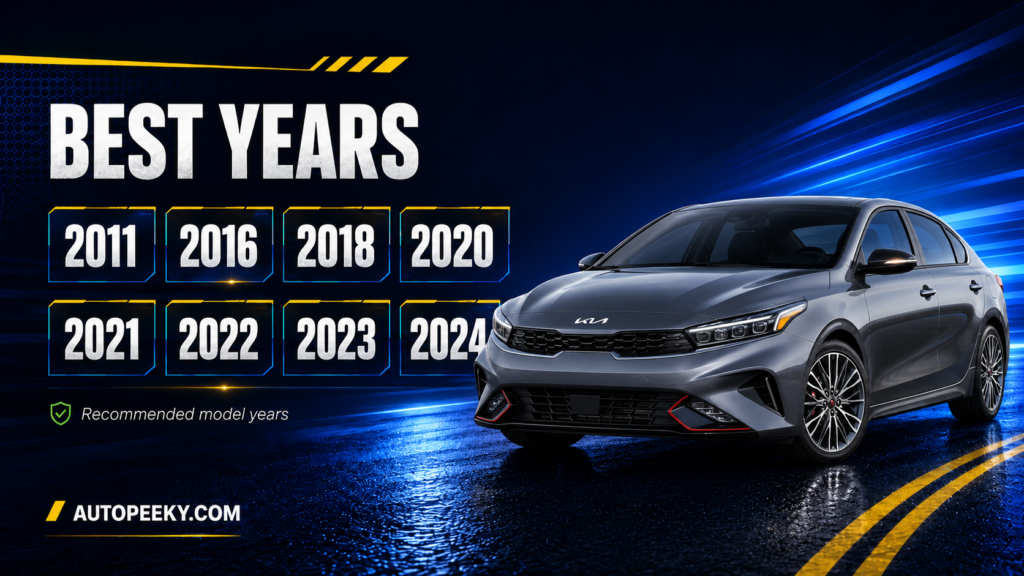
The short version: Avoid the 2010, 2012, 2014, 2015, 2017, and 2019. Target the 2011, 2016, 2018, or any 2020–2024 for a dependable ownership experience.
Now let’s go generation by generation to understand exactly why.
1st Generation Kia Forte (2010–2013): Best & Worst Years
The first-generation Forte arrived in the US for 2010 as Kia’s successor to the aging Spectra. It made an immediate impression with contemporary styling, a comfortable interior, and an aggressive starting price. But those early years were rougher than Kia’s marketing suggested.
Worst Years: 2010 & 2012 – Kia Forte Years to Avoid
The 2010 Kia Forte is the single most problematic year in the model’s entire history and it’s primarily down to one catastrophic issue: rod bearing failure in the 2.0L and 2.4L four-cylinder engines.
Faulty rod bearings compounded by oil pump failures that starved the engine of lubrication caused a distinctive knocking sound from the engine bay that rapidly escalated to complete engine seizure. For many owners, this happened well before 100,000 miles. In some cases, it happened under 60,000 miles. Engine replacement or rebuild costs start at $3,000 and can reach $6,000+ at a dealership.
The 2010 wasn’t just an engine story, though. It also accumulated significant complaints around:
- Interior electrical failures – push-start button malfunctions, inoperable windshield wipers, non-responsive climate controls
- Suspension and brake concerns – owners reported mushy brake feel and premature wear
- Brake lamp switch malfunction – a recall-level defect that affected lighting reliability and the ability to disengage cruise control
Fire risk was also documented in NHTSA filings engine compartment fires linked to the oil system failures. For a compact sedan in this price range, that’s an unacceptable safety reality.
The 2012 Kia Forte continued the engine narrative with the now-infamous Theta II engine failures. The Theta II (used across multiple Kia and Hyundai models of this era) was found to produce metal shavings during manufacturing shavings that circulated through the oil system and accelerated wear on bearings, connecting rods, and other internal components.
The result: engines seizing before 100,000 miles, often with very little warning beyond the check engine light. This issue became significant enough to generate class-action litigation against Kia and Hyundai.
On top of the engine concerns, 2012 Forte owners reported:
- HECU (Hydraulic Electronic Control Unit) short circuits that created fire risk from the brake system electronics
- Seat belt retractor issues that triggered a safety recall
- Engine compartment fire risk linked to the HECU defect
The combined weight of Theta II engine failures, fire-related recalls, and elevated NHTSA complaint volumes makes 2012 a year to skip without hesitation.
Neutral Year: 2013
The 2013 Forte benefited from Kia’s ongoing refinements and represented a meaningful improvement over 2010 and 2012 but it wasn’t entirely clean.
Two recalls affected the 2013 model: a brake pedal stopper failure that could cause unexpected brake behavior, and an HECU short circuit risk similar to the 2012 concern. Neither reached the scale of the earlier years’ problems, but they’re worth knowing about.
On the positive side, the 2013 added optional navigation, updated infotainment connectivity, and slightly improved interior materials. If you’re buying a first-gen Forte and the 2011 is unavailable at the right price, a confirmed-recall-completed 2013 is an acceptable alternative.
Best Year: 2011 – Best 1st Gen Kia Forte
The 2011 Kia Forte is the clear standout of the first generation and the only year AutoPeeky recommends without qualification from this era.
Why did 2011 escape the problems that plagued 2010 and 2012? Kia made targeted improvements to the engine’s lubrication system and addressed early build quality concerns from the debut year before the Theta II issues became fully embedded in the 2012 production run.
The 2011 offered two solid powertrain options:
- 2.0L I4 producing 156 horsepower -fuel economy of 25 city / 35 highway MPG, which remains respectable today
- 2.4L I4 producing 173 horsepower for buyers wanting a bit more performance
Available trims gave buyers genuine choice: the EX prioritized comfort and features, while the SX offered a sportier feel with upgraded suspension tuning. Both came with Bluetooth and a six-speaker audio system as standard competitive tech for the period.
Tie rod end wear was the most commonly reported 2011 concern, but far less costly and dramatic than a failed engine. Consumer Reports and Edmunds owner satisfaction scores for 2011 were notably higher than any other first-gen year.
If you need a first-gen Forte, 2011 is the only year worth considering.
2nd Generation Kia Forte (2014–2018): Best & Worst Years
The second-generation Forte arrived for 2014 with a more polished exterior, a significantly upgraded interior, and Kia’s ambition to move the model slightly upmarket. It was a better vehicle in most measurable ways but the first three years repeated the same debut-year reliability pattern that plagued the first generation.
Worst Years: 2014, 2015 & 2017 – Kia Forte Years to Avoid
The 2014 Forte inherited the Theta II engine concerns from the previous generation and added several new problems of its own.
Most critically: engine fires and engine failures continued to generate NHTSA complaints at an elevated rate. Kia was actively managing Theta II-related issues across its lineup during this period, and the 2014 Forte was squarely in the affected pool.
Electrical gremlins became a new theme. Owners reported random warning lights, electrical accessory failures, and infotainment system crashes that dealers struggled to diagnose. Most frustratingly, steering coupler failures emerged: a worn or defective intermediate steering shaft produced clicking and grinding noises during low-speed maneuvers, and in more serious cases, unpredictable steering behavior that led to a recall.
Cooling fan resistor failures triggered yet another recall, melting resistors created a fire risk under the hood. For a mid-cycle car, the 2014 Forte accumulated recall activity at an uncomfortable pace.
The 2015 Forte continued the engine fire and failure narrative. NHTSA complaint data shows elevated engine-related submissions for 2015, consistent with ongoing Theta II concerns in Kia’s lineup. While the electrical gremlins of 2014 were partially addressed, the engine reliability question mark remained.
The 2017 Forte earns its avoid rating for a different set of reasons. By this point, Kia had significantly reduced Theta II-related failures but introduced new problems:
- Oil pump failures led to a NHTSA recall, with insufficient oil pressure potentially causing engine stalling in traffic
- Engine stalling without warning was among the most common owner complaints filed against 2017
- Headlight flickering intermittent headlight failure while driving at night was a safety-relevant issue reported widely enough to generate NHTSA attention
- Airbag deployment concerns added to the safety picture
The 2017’s headlight and stalling issues are particularly concerning from a safety standpoint, making it a year to avoid even though it escaped the Theta II fire concerns that plagued 2014 and 2015.
Best Years: 2016 & 2018 – Best 2nd Gen Kia Forte
The 2016 Kia Forte is the single best year of the second generation and according to Edmunds reliability data, one of the most reliable Forte years across all three generations.
Kia largely resolved the Theta II concerns by 2016, and the powertrain choices were well-sorted:
- 1.8L I4 producing 145 horsepower smooth, fuel-efficient at 26 city / 37 highway MPG
- 2.0L I4 producing 173 horsepower for a more responsive driving experience
- 6-speed automatic transmission across both engines notably smoother than what first-gen buyers experienced
The 2018 Forte rounds out the second generation on a strong note. The standout addition for 2018 was a new 2.0L Atkinson cycle engine, an efficient variant that delivers 29 city / 37 highway MPG in the base LX trim, making it one of the most fuel-efficient non-hybrid compact sedans of the period.
Higher trims in 2018 gained a 7-inch touchscreen with Apple CarPlay and Android Auto, upgraded interior materials, heated front seats, and sunroof availability in the EX trim features that push the Forte’s value proposition up against rivals from Honda and Toyota. Reliability data for 2018 is strong, and owner satisfaction scores on Cars.com and KBB ranked it among the top compact sedans in its price bracket.
Read More: Best & Worst Toyota Avalon Years
3rd Generation Kia Forte (2019–Present): Best & Worst Years
The third-generation Forte arrived for 2019 as Kia’s most dramatic reinvention of the model yet. A genuinely striking exterior design, a significantly improved interior, standard safety technology, and a new Intelligent Variable Transmission (IVT) made the BD-generation Forte feel like a different vehicle from its predecessors. But the debut year stumbled.
Worst Year: 2019 – Kia Forte Year to Avoid
The 2019 Forte was a compelling car on paper but first-year buyers paid the price for being early adopters.
Transmission problems were the defining complaint. The new IVT (Intelligent Variable Transmission) suffered from shuddering, slipping, and rough behavior during low-speed gear changes. In more serious cases, owners reported complete transmission failures before 30,000 miles, an alarming failure rate for a brand-new powertrain. IVT replacement is not an inexpensive repair.
Engine reliability concerns also appeared in 2019 ]not at the Theta II level of severity, but elevated relative to what became normal for the third generation.
A/C and heater system failures were among the most frequently filed 2019 complaints on NHTSA, a comfort-system issue that proved difficult for dealers to resolve consistently.
Body and paint quality drew significant criticism: panel alignment concerns and peeling clear coat were documented at rates higher than class competitors.
The 2019 is a year where the Forte’s excellent design masks real first-year reliability issues. Kia addressed most of these by 2020 which is exactly why waiting for the next model year is worth it.
Best Years: 2020, 2021, 2022, 2023 & 2024
These five years represent the Kia Forte at its finest and they collectively make a strong case that the third-generation BD Forte is the best compact sedan Kia has ever built.
Powertrain: The 2.0L I4 producing 147 horsepower pairs with either a 6-speed manual (a rare and appreciated option in the segment) or the refined IVT now properly sorted after its 2019 debut stumbles. Fuel economy reaches 31 city / 41 highway MPG with the IVT, genuinely class-competitive numbers.
Safety: Standard forward-collision avoidance assist, lane-keeping assist, and driver attention warning across all trims from 2020 forward. This is active safety technology that was optional or unavailable in competing models at the same price point.
Technology: 8-inch touchscreen standard across the lineup, with Apple CarPlay and Android Auto compatibility. The GT and EX trims add wireless charging, a Bose or Harman Kardon premium audio system, and a larger 10.25-inch digital instrument cluster.
Interior: The third-gen Forte’s cabin quality genuinely surprised reviewers material quality, fit and finish, and ergonomics punch above the car’s price class.
Reliability breakdown by year:
- 2020 – NHTSA complaint volumes dropped dramatically from 2019. Strong transmission reliability with the resolved IVT. AutoPeeky reliability score: 4.5/5
- 2021 – Among the best third-gen years for owner satisfaction. Facelifted exterior and interior details. Low complaint volume. AutoPeeky reliability score: 4.5/5
- 2022 – 75/100 reliability score from Auto Reliability Index. Only 25 NHTSA complaints on record. AutoPeeky reliability score: 4.5/5
- 2023 – 56 NHTSA complaints higher than 2022 but still well within acceptable range for a car this age in the complaint accumulation cycle. AutoPeeky reliability score: 4/5
- 2024 – 0 recalls, 20 NHTSA complaints, 78/100 reliability score. The best-data year in the entire Forte lineup. AutoPeeky reliability score: 5/5
Also Read: Toyota Venza Best and Worst Years
The Theta II Engine Problem: What Every Kia Forte Buyer Must Know
If you’re shopping a 2010–2017 Kia Forte, the Theta II engine issue deserves your full attention because it’s the most consequential reliability factor in the model’s history.
The Theta II (2.0L and 2.4L GDI versions) was found to produce metal debris during manufacturing debris that contaminated the engine oil and gradually scored critical engine components including rod bearings, connecting rods, and cylinder walls. The result: engines that failed catastrophically, often without much warning beyond an oil light or knocking sound.
This affected Kia Forte models from 2012 through approximately 2017, and was widespread enough to trigger class-action lawsuits and multiple NHTSA investigations. Kia extended warranty coverage on many affected vehicles to 10 years / 100,000 miles for engine failures attributable to this defect.
What to do: Before buying any 2012–2017 Forte, check whether the specific VIN was covered under Kia’s engine warranty extension. Ask for records showing the oil was changed regularly (Theta II failures were accelerated by infrequent oil changes). Have a mechanic check for any engine knocking or oil consumption prior to purchase.
Kia Forte Annual Maintenance Cost
According to RepairPal data, the Kia Forte averages $451 per year in maintenance and repair costs $75 below the compact car segment average of $526. This is one of the Forte’s genuine competitive advantages: it’s not just affordable to buy, it’s affordable to own.
That said, this average masks significant variation by model year. A 2020–2024 Forte with no engine or transmission concerns will likely come in well under that average. A 2014 Forte with unresolved Theta II concerns could easily exceed $3,000 in a single repair event.
The year you choose directly determines whether the $451 average applies to your ownership experience or whether you’re an outlier.
Is the Kia Forte a Good Car?
Yes, with the right model year, the Kia Forte is a genuinely good compact sedan. Here’s AutoPeeky honest assessment:
Where the Forte excels:
- Class-leading fuel economy (41 MPG highway for 2020–2024)
- Sporty, modern exterior design that aged better than most class rivals
- Standard active safety tech from 2020 forward
- Below-average annual maintenance costs ($451/year)
- The GT-Line and GT trims offer a genuinely fun driving character rare in budget sedans
Where the Forte falls short:
- Rear seat legroom is tight for taller passengers
- The IVT transmission (2019 debut year) had a troubled start
- Certain 2010–2017 engines have a documented failure history that requires careful pre-purchase research
- Resale value is below Honda Civic and Toyota Corolla benchmarks
Versus the competition: The 2020–2024 Forte competes directly with the Honda Civic, Toyota Corolla, Mazda3, and Hyundai Elantra. On features per dollar, it consistently ranks among the top two or three in the segment. On long-term reliability, the 2020–2024 models have closed the historical gap with Honda and Toyota considerably.
Kia Forte Year-by-Year Summary
| Year | Rating | Key Notes |
| 2010 | ❌ Avoid | Rod bearing failure, oil pump faults, fire risk, high complaints |
| 2011 | ✅ Best | Most reliable 1st gen — strong powertrain, high owner satisfaction |
| 2012 | ❌ Avoid | Theta II engine failures, HECU fire recall, seat belt recall |
| 2013 | ⚠️ Neutral | Brake pedal stopper recall, HECU concerns — acceptable if priced right |
| 2014 | ❌ Avoid | Theta II fires, steering coupler failure, cooling fan recall |
| 2015 | ❌ Avoid | Continued engine fire risk, elevated NHTSA complaint volume |
| 2016 | ✅ Best | Best 2nd gen year — sorted engine, strong reliability, lowest complaint count |
| 2017 | ❌ Avoid | Oil pump recall, engine stalling, headlight failures |
| 2018 | ✅ Best | Atkinson engine great on fuel, strong tech package, clean reliability |
| 2019 | ❌ Avoid | IVT transmission failures, A/C issues, body quality complaints |
| 2020 | ✅ Best | IVT resolved, standard safety suite, dramatically lower complaints |
| 2021 | ✅ Best | Facelifted, high owner satisfaction, low NHTSA volume |
| 2022 | ✅ Best | 75/100 reliability score, only 25 complaints — excellent used buy |
| 2023 | ✅ Best | Well-rounded, reliable, great value on used market |
| 2024 | ✅ Best | 0 recalls, 78/100 reliability score — best Forte ever built |
AutoPeeky Top Pick: The Best Kia Forte Year to Buy
After analyzing every model year from 2010 through 2024, here is AutoPeeky’s verdict:
The 2022 Kia Forte is the best used buy in the model’s entire history.
Here’s the case for the 2022:
- 75/100 reliability score among the highest of any Forte year on record
- Only 25 NHTSA complaints one of the lowest in the dataset
- Standard forward-collision avoidance, lane-keeping assist, and driver attention warning
- 31 city / 41 highway MPG genuinely outstanding fuel economy
- Apple CarPlay, Android Auto, and 8-inch touchscreen standard
- Now available in the used market at attractive pricing as it ages out of the new-car consideration set
- Strong resale value trajectory for a budget sedan
If budget allows for newer, the 2024 Forte (0 recalls, 20 complaints, 78/100 reliability) is the safest possible Forte purchase. For buyers looking for the oldest reliable option, the 2016 Forte remains a dependable choice in the used market at a lower price point.
Conclusion
The Kia Forte has earned its place as one of the better-value compact sedans on the market but only in the right model years. The early years of each generation carry real, documented reliability risks that no amount of attractive styling or aggressive pricing should paper over.
Buy the 2022, 2020, or 2021 for the strongest combination of reliability, technology, and value. The 2024 is the cleanest buy if your budget allows for something near-new. If you need to go older, 2016 or 2018 are the only second-gen years worth considering, and 2011 is the only safe first-gen option.
Avoid the years flagged in this guide particularly 2010, 2012, 2014, 2015, 2017, and 2019 and the Kia Forte becomes a genuinely smart choice in a competitive class.
Before signing anything, verify the VIN at NHTSA.gov, confirm all recalls are closed on the specific car, and get a pre-purchase inspection from a Kia-familiar mechanic.
Have a question about a specific Forte year or trim? Drop it in the comments below the AutoPeeky team reads every one.
FAQ’s
What year Kia Forte should I avoid?
The Kia Forte years to avoid are 2010, 2012, 2014, 2015, 2017, and 2019. These model years have the highest documented NHTSA complaint volumes, the most significant safety recalls, and the most costly documented failure modes particularly the Theta II engine failures that affected 2012–2017 models and the IVT transmission issues that plagued the 2019 debut year.
What is the best year for a used Kia Forte?
The best year for a used Kia Forte is the 2022 model, which combines a 75/100 reliability score, only 25 NHTSA complaints, standard active safety technology, and excellent 41 MPG highway fuel economy all at a price point that’s now very accessible in the used market. 2020 and 2021 are equally strong alternatives.
Did Kia Forte have engine problems?
Yes the Kia Forte had significant engine problems in the 2010, 2012, 2014, 2015, and 2017 model years. The primary cause in 2012–2017 models was the Theta II engine, which produced metal debris during manufacturing that led to rod bearing failures and engine seizure, often before 100,000 miles. The 2010 had separate rod bearing issues linked to oil pump failures. Kia extended engine warranty coverage on many affected vehicles as a result.
Is the Kia Forte reliable long-term?
The reliability of a Kia Forte long-term depends entirely on the model year. The 2020–2024 third-generation models have demonstrated strong reliability with low complaint volumes and no significant powertrain defects. These cars, with proper maintenance, should comfortably reach 150,000–200,000 miles. Earlier years particularly 2010–2015 carry more risk due to documented engine failure histories.
What does the Kia Forte cost to maintain per year?
The Kia Forte averages $451 per year in maintenance and repair costs according to RepairPal data, $75 below the compact car segment average of $526. This makes it one of the more affordable compact sedans to own long-term, provided you’re buying a model year without documented reliability issues.
How does the Kia Forte compare to the Honda Civic and Toyota Corolla?
In the 2020–2024 model years, the Kia Forte competes directly with the Honda Civic and Toyota Corolla. The Forte typically wins on features per dollar and fuel economy, while the Civic and Corolla have stronger long-term resale values and a longer established reliability track record. The gap in reliability has narrowed considerably with the third-gen Forte, making it a legitimate contender for budget-conscious buyers.
Is the Kia Forte GT worth buying?
Yes the Kia Forte GT is worth considering in the 2020–2024 model years. It adds a turbocharged 1.6L I4 producing 201 horsepower, a 7-speed dual-clutch transmission, and sport-tuned suspension. It delivers a genuinely engaging driving experience unusual in the budget sedan class. Reliability data for the GT is similar to the standard Forte in the same years solid from 2020 onward.
What should I check before buying a used Kia Forte?
Before buying any used Kia Forte, check: (1) the full VIN recall history at NHTSA.gov to confirm all open recalls are completed; (2) for 2012–2017 models, confirm whether the engine was covered under Kia’s extended warranty program and request oil change records; (3) the transmission behavior on a test drive any shuddering or slipping in 2019 models is a red flag; (4) engine noise any ticking or knocking in pre-2018 models warrants investigation; (5) an OBD-II diagnostic scan for stored fault codes before completing any purchase.